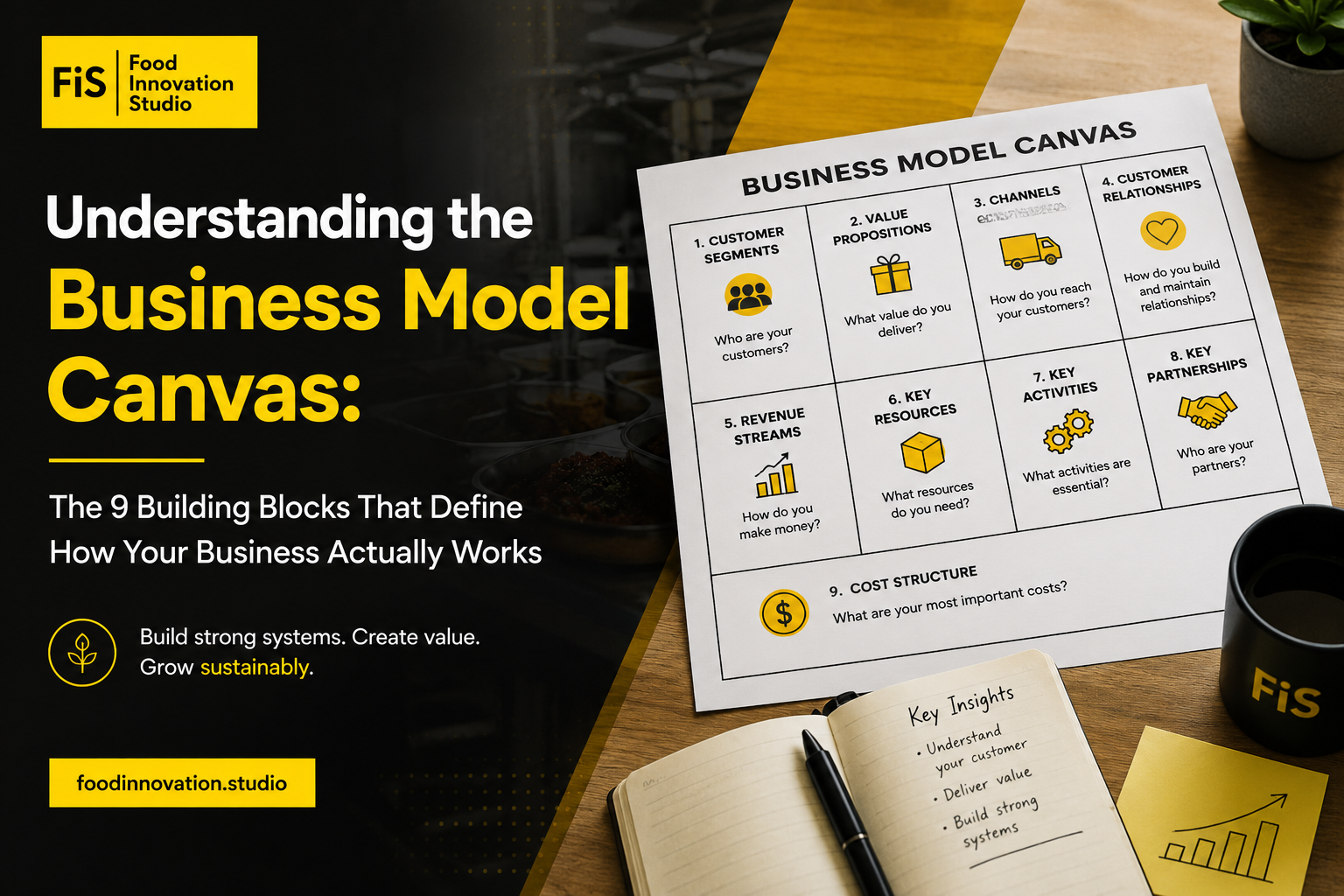
Understanding the Business Model Canvas: The 9 Building Blocks That Define How Your Business Actually Works
Understanding your business goes beyond having a great product or idea. The Business Model Canvas provides a practical framework for visualizing how your organization creates, delivers, and captures value. Explore the nine essential building blocks that define how your business actually works and learn how stronger systems lead to sustainable growth and scalability.
Introduction
Many businesses do not fail because they have bad ideas. They fail because they do not fully understand how their businesses actually work. Founders often spend months refining products, designing brands, creating marketing campaigns, and searching for funding, yet struggle to answer a few simple questions: Who exactly is the customer? Why would they buy? How does the business generate value? How does money move through the system? What activities keep the business operating?
A business is much more than a product. It is a system of interconnected parts that must work together. When one part becomes weak, the entire structure begins to experience strain. Growth becomes inconsistent, operations become reactive, and decision-making becomes difficult.
This is where the Business Model Canvas becomes valuable.
The Business Model Canvas is a strategic framework that helps organizations visualize how a business creates, delivers, and captures value. Rather than writing a long and static business plan that may quickly become outdated, the canvas provides a simple but powerful structure that helps founders understand the complete picture of their businesses.
Developed by Alexander Osterwalder, the Business Model Canvas breaks a business into nine core building blocks. Together, these blocks provide a practical map showing how an organization functions and how each component influences the others.
Whether you are building a startup, expanding a food manufacturing business, launching a digital platform, or developing a social enterprise, understanding these nine blocks can help you create stronger systems and more sustainable growth.
The Business Model Canvas at a Glance
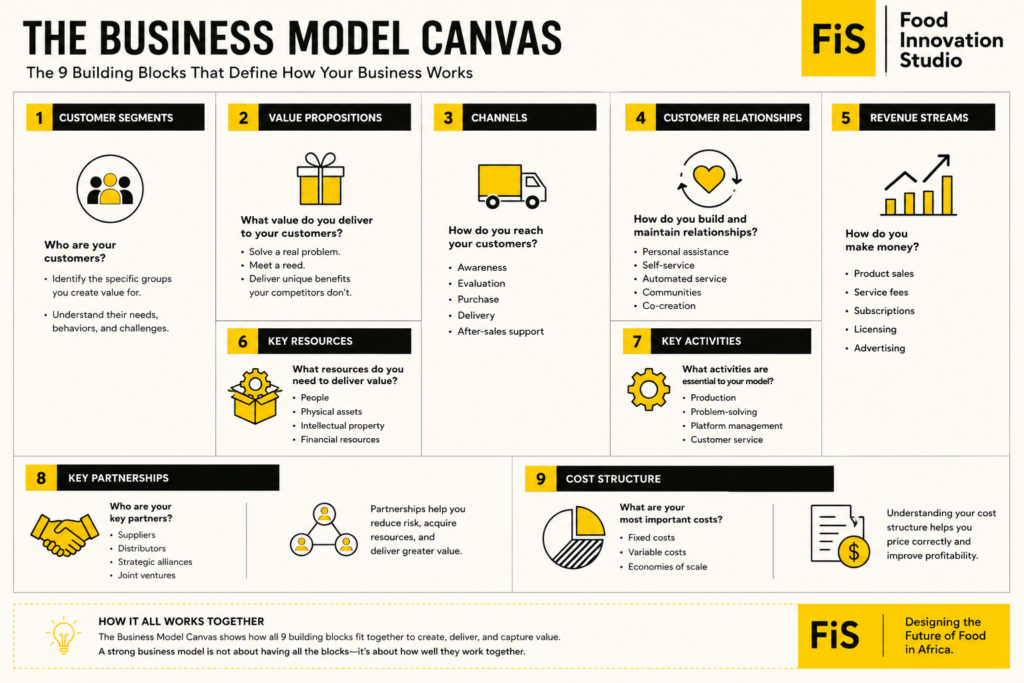
Before diving into each component individually, it helps to see the complete picture. The Business Model Canvas provides a visual framework showing how the nine building blocks connect to create, deliver, and capture value within a business system.
Figure 1: The Business Model Canvas framework showing the nine interconnected building blocks that define how a business creates, delivers, and captures value.
Why Understanding Your Business Model Matters
Many entrepreneurs begin with excitement around a solution. They see a market opportunity, identify a challenge, and immediately start building products or services. While passion is important, growth becomes difficult when the underlying business structure remains unclear.
A business model explains more than what a company sells. It explains how value moves through the organization.
It answers critical questions such as:
Who are we serving?
What problem are we solving?
Why would customers choose us?
How do we reach them?
How do we generate revenue?
What resources and partnerships make this possible?
Without clarity around these questions, businesses often encounter common challenges. They struggle to identify customers accurately, fail to establish reliable revenue systems, spend resources inefficiently, and find it difficult to scale operations.
The Business Model Canvas creates alignment by helping founders see relationships between all moving parts.
Building Block 1: Customer Segments
Everything begins with the customer.
Customer segments define the groups of people or organizations a business aims to serve. A business cannot effectively serve everyone. Trying to satisfy everyone often results in weak positioning and diluted value.
Instead, organizations must intentionally identify specific groups with shared characteristics, behaviors, needs, or challenges.
Customer segments can include:
Mass markets
Niche markets
Segmented markets
Diversified markets
Multi-sided platforms
For example, a food innovation platform may serve multiple customer groups including food startups, investors, hospitality businesses, and institutions.
Each segment may have different motivations and expectations.
Questions to ask:
Who are our most important customers?
Whose problem are we solving?
Which customer groups generate the greatest value?
What needs define each customer segment?
Understanding customer segments creates focus and allows businesses to design products, services, and experiences that directly address real needs.
Building Block 2: Value Proposition
Once customer groups are identified, the next step is understanding why customers would choose your business.
The value proposition explains the value being created.
It defines how your business solves problems or fulfills needs better than alternatives.
Many founders mistakenly assume their product itself is the value proposition. In reality, customers rarely buy products simply because they exist.
Customers buy outcomes.
They buy convenience.
They buy savings.
They buy efficiency.
They buy trust.
They buy experiences.
A food startup, for example, may believe it sells packaged food products. However, customers may actually be purchasing healthy convenience, cultural authenticity, nutritional value, or reliability.
Questions to ask:
What value do we deliver?
What problem are we solving?
Why should customers choose us instead of competitors?
Which needs are being addressed?
Strong value propositions create differentiation and provide reasons for customers to engage.
Building Block 3: Channels
Even when businesses understand customers and create valuable solutions, success depends on reaching customers effectively.
Channels describe how organizations communicate with customers and deliver value.
Channels include every touchpoint through which customers discover, evaluate, purchase, and experience products or services.
Examples include:
Physical stores
Websites
Social media
Mobile applications
Email marketing
Sales teams
Distribution networks
Partners
Different channels serve different purposes.
Some create awareness.
Others support evaluation and purchasing.
Others strengthen customer experience after purchase.
Questions to ask:
How do customers want to be reached?
Which channels are most effective?
Which channels are cost-efficient?
How do channels integrate with customer routines?
Strong channels create seamless experiences and reduce friction between customer needs and business solutions.
Building Block 4: Customer Relationships
Acquiring customers is important.
Keeping customers often matters even more.
Customer relationships define how organizations interact with customers throughout their journeys.
Relationships influence customer satisfaction, loyalty, and long-term growth.
Examples include:
Personal assistance
Dedicated support
Self-service systems
Communities
Automated services
Co-creation approaches
Subscription engagement
Modern businesses increasingly recognize that relationships extend beyond transactions.
Strong relationships build trust and create advocacy.
Questions to ask:
What relationships do customers expect?
How should we interact with customers?
How do relationships support retention?
How can relationships create long-term value?
Building Block 5: Revenue Streams
Revenue streams explain how money enters the business.
Without revenue, sustainability becomes impossible.
Revenue streams describe how organizations capture value from customers.
Common revenue models include:
Product sales
Subscription fees
Licensing
Advertising
Commission models
Membership systems
Usage fees
Freemium approaches
Businesses may use multiple revenue streams simultaneously.
A food innovation platform, for example, could generate revenue from educational programs, consulting services, subscriptions, and partnerships.
Food Innovation Studio (FiS) is excited to announce its participation in the HERE AFRICA Food & Drink Festival 2026, one of Nairobi’s most vibrant celebrations of food, culture, entrepreneurship, and innovation.
A strong value proposition connects your product to a real customer problem. Learn how to identify customer pain points, define meaningful outcomes, and create value propositions that drive growth, loyalty, and competitive advantage.
Food Innovation Studio (FiS) is excited to announce its participation in the HERE AFRICA Food & Drink Festival 2026, one of Nairobi’s most vibrant celebrations of food, culture, entrepreneurship, and innovation.
A strong value proposition connects your product to a real customer problem. Learn how to identify customer pain points, define meaningful outcomes, and create value propositions that drive growth, loyalty, and competitive advantage.
Food Innovation Studio (FiS) was proud to participate in Roots & Routes: A Celebration of Wine & Local Food Culture, an industry gathering hosted by Hello Tractor and Wine Routes Africa that brought together leaders from across the food, agriculture, culture, and innovation ecosystems.
Food Innovation Studio (FiS), in collaboration with Manufacturing Business School, hosted a webinar focused on the principles, systems, and strategies required to build scalable food manufacturing businesses across Africa.
As food businesses grow, maintaining product quality, operational efficiency, and production consistency becomes increasingly important. The session explored practical approaches to scaling food manufacturing operations while minimizing common growth challenges.
Food Innovation Studio, in collaboration with Manufacturing Business School, is hosting a practical webinar focused on strengthening food manufacturing operations, maintaining quality standards, and reducing operational waste across Africa’s food systems.
To provide the best experiences, we use technologies like cookies to store and/or access device information. Consenting to these technologies will allow us to process data such as browsing behaviour or unique IDs on this site. Not consenting or withdrawing consent, may adversely affect certain features and functions.
Functional
Always active
The technical storage or access is strictly necessary for the legitimate purpose of enabling the use of a specific service explicitly requested by the subscriber or user, or for the sole purpose of carrying out the transmission of a communication over an electronic communications network.
Preferences
The technical storage or access is necessary for the legitimate purpose of storing preferences that are not requested by the subscriber or user.
Statistics
The technical storage or access that is used exclusively for statistical purposes.The technical storage or access that is used exclusively for anonymous statistical purposes. Without a subpoena, voluntary compliance on the part of your Internet Service Provider, or additional records from a third party, information stored or retrieved for this purpose alone cannot usually be used to identify you.
Marketing
The technical storage or access is required to create user profiles to send advertising, or to track the user on a website or across several websites for similar marketing purposes.