
Introduction
One of the biggest misconceptions in entrepreneurship is the belief that customers buy products.
They do not.
Customers buy solutions. They buy convenience, confidence, efficiency, savings, health, status, peace of mind, and better outcomes. The product itself is simply the mechanism that delivers those outcomes.
This distinction may seem subtle, but it is one of the most important concepts in business strategy. Every successful company, from global technology giants to local food startups, has achieved growth because it solved a meaningful problem for a specific group of customers. The businesses that struggle are often those that become obsessed with their products while losing sight of the customer challenges those products are supposed to solve.
This is where the concept of a value proposition becomes critical.
A value proposition sits at the heart of every successful business model. It explains why customers choose one solution over another, what unique value a company provides, and how that value addresses a real customer need. Within the Business Model Canvas, the value proposition occupies the central position because every other aspect of the business exists to support its creation and delivery.
For food entrepreneurs, manufacturers, processors, agribusinesses, hospitality businesses, and food technology startups, understanding value propositions is particularly important. The food industry is highly competitive, customer expectations are constantly evolving, and consumers have more choices than ever before. Businesses that understand customer pain points and build solutions around them create stronger brands, stronger customer relationships, and stronger revenue streams.
In this article, we will explore the meaning of a value proposition, why it matters, how businesses can identify customer pain points, how customer gains influence purchasing decisions, and how food businesses can create compelling value propositions that drive sustainable growth.
What Is a Value Proposition?
A value proposition is a clear, concise statement that explains the value a business creates for its customers. It describes the specific problem being solved, the customer group being served, and the unique benefits that customers receive from choosing that solution.
In simple terms, a value proposition answers one fundamental question:
Why should a customer choose your product or service instead of an alternative?
Many businesses struggle because they communicate what they do rather than why it matters. Consider a food startup that sells packaged fruit juice.
A weak value proposition might say:
- “We manufacture premium fruit juice.”
While technically correct, this statement focuses entirely on the product. It does not explain why a customer should care.
A stronger value proposition would say:
- “We help busy professionals enjoy healthy nutrition on the go without sacrificing convenience.”
The second statement immediately communicates customer value. It addresses a problem (lack of time for nutrition), identifies a target audience (busy professionals), and highlights a desired outcome (health and convenience).
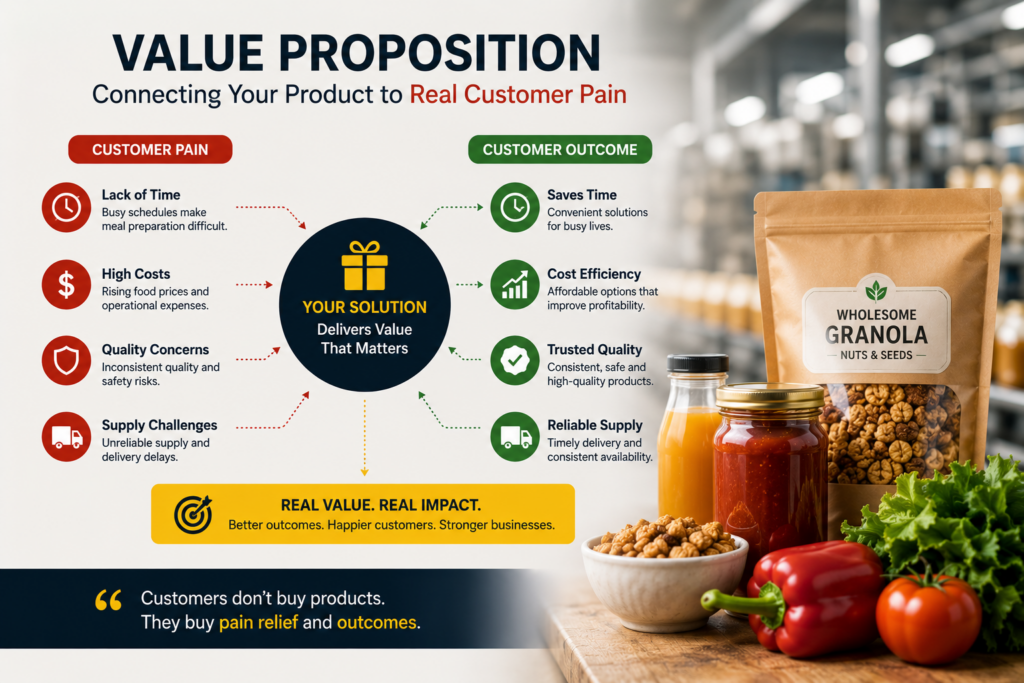
This shift from product thinking to customer thinking is what separates successful businesses from struggling ones. Customers rarely purchase products because of features alone. Instead, they evaluate whether a product helps them achieve something important. They ask questions such as:
- Will this save me time?
- Will this reduce my costs?
- Will this improve my health?
- Will this make my life easier?
- Will this help my business grow?
- Will this reduce risk?
The businesses that answer these questions effectively develop stronger value propositions and stronger competitive positions.
Why Value Propositions Matter in Business Strategy
A strong value proposition is not simply a marketing statement or a catchy slogan to place on a website homepage. It is an operational compass that influences every major decision within a business, acting as the foundation upon which all organizational activities are built.
When a company clearly understands the value it provides, it becomes easier to develop products, design marketing campaigns, build customer relationships, establish pricing strategies, and allocate resources effectively. It bridges the gap between internal operations and external market realities.
+-------------------------------------------------------------+
|                  THE VALUE PROPOSITION                      |
+-------------------------------------------------------------+
         |                  |                 |
         v                  v                 v
+-----------------+ +---------------+ +---------------+
| Product Dev     | | Marketing     | | Pricing       |
| Focuses only on | | Speaks direct | | Based on true |
| high-value      | | to customer   | | perceived     |
| features.       | | pains.        | | ROI.          |
+-----------------+ +---------------+ +---------------+
Without a clear value proposition, businesses often operate without strategic focus. Teams may invest capital into engineering product features that customers do not actually want or value. Marketing campaigns may attract the wrong audience, leading to high traffic but abysmal conversion rates. Sales teams may struggle to explain why customers should buy from them instead of a legacy competitor, reverting to costly price discounts to close deals. Leadership teams may chase shiny new market opportunities that do not align with core customer needs, diluting the brand’s footprint.
This challenge is particularly common among startups and early-stage entrepreneurs. Many founders begin with a product idea rather than a validated customer problem. They spend months refining products, developing packaging, designing logos, and building websites before validating whether customers genuinely need or want the solution. They fall in love with their creation, assuming that the market will share their enthusiasm automatically.
As a result, these businesses often experience what appears to be growth during their initial launch phase – driven by novelty and initial promotion – but lacks a strong foundation. They may generate occasional, erratic sales, but customer retention remains weak because the underlying value proposition is unclear or unappreciated.
Strong value propositions create internal and external clarity. They align the entire organization around delivering meaningful value to customers. They also provide a concrete framework for evaluating future opportunities, ensuring that business growth remains deeply connected to customer needs. In highly competitive industries such as food manufacturing, food processing, hospitality, and food technology, a strong value proposition can become one of the most important sources of sustainable competitive advantage.
The Anatomy of a Value Proposition: The Value Proposition Canvas
To build a value proposition that resonates with the market, businesses need a structured framework to map out customer needs and align their products accordingly. The most effective tool for this exercise is the Value Proposition Canvas, developed by Dr. Alexander Osterwalder. This framework breaks the value proposition down into two distinct sides: The Customer Profile and The Value Map.
       THE VALUE MAP                         THE CUSTOMER PROFILE
    +-----------------+                     +-----------------+
    |  Pain Relievers | ---- Addresses ---> |   Pain Points   |
    +-----------------+                     +-----------------+
    |  Gain Creators  | ---- Enhances ----> |  Customer Gains |
    +-----------------+                     +-----------------+
    | Products/Serv.  | ---- Satisfies ---> |  Customer Jobs  |
    +-----------------+                     +-----------------+
The magic of a great value proposition happens when these two sides achieve Problem-Solution Fit. This occurs when the features of your product directly address the most pressing elements of your customer’s daily reality. Let us break down the components of both sides to understand how they interact.
1. The Customer Profile
The Customer Profile focuses entirely on understanding the target market. It forces you to look at the world through your customer’s eyes, mapping out three distinct dimensions:
- Customer Jobs: These are the tasks, problems, or needs your customers are trying to address in their work or personal lives. Jobs can be functional (e.g., preparing a quick dinner), social (e.g., impressing dinner guests), or emotional (e.g., feeling healthy and responsible).
- Customer Pains: These represent anything that annoys, frustrates, or endangers the customer before, during, or after trying to get a job done. It includes risks, negative emotions, obstacles, and financial costs.
- Customer Gains: These are the positive outcomes, benefits, and desires that your customers want to achieve. Some gains are required or expected, while others are unexpected bonuses that delight them.
2. The Value Map
The Value Map describes how your product or service is structured to address that specific Customer Profile. It is the mirror image of your customer’s realities:
- Products and Services: This is simply the list of what you offer. It is the bundle of goods or services that helps customers complete their jobs.
- Pain Relievers: This section outlines exactly how your products or services alleviate specific customer pains. It details how you eliminate frustrations, reduce costs, remove obstacles, or mitigate risks.
- Gain Creators: This section specifies how your products or services produce the outcomes and benefits that your customers expect, desire, or would be surprised by.
Achieving fit means aligning your Pain Relievers with their top Pain Points, and your Gain Creators with their top Customer Gains. You do not need to address every single pain and gain listed on the canvas; you simply need to address the most severe ones with absolute precision.
Deep Dive into Customer Pain Points
To build a value proposition that drives immediate action, you must understand customer pain points at a granular level. A pain point is a specific, recurring problem that causes friction, distress, or financial loss for your target audience. If your value proposition does not clear away a significant barrier for the customer, they will remain comfortable with the status quo.
Customer pain points generally fall into four primary categories, each requiring a different approach to solve:
| Pain Point Category | Description | Food Industry Example |
| Financial Pains | The customer is spending too much money on their current solutions and needs to reduce costs. | A restaurant spending excessive capital on fresh produce that spoils before it can be used. |
| Productivity Pains | The customer is wasting too much time or effort completing a task and requires greater efficiency. | A working parent spending two hours every evening cooking and cleaning up after a meal. |
| Process Pains | The customer experiences friction, confusion, or logistical hurdles within their daily operations. | A boutique grocery retailer struggling to track inventory across multiple fragmented local suppliers. |
| Support Pains | The customer feels abandoned or poorly guided during their purchasing journey or usage lifecycle. | A commercial bakery unable to get technical support when a commercial oven breaks down mid-shift. |
The Danger of Ghost Pain Points
One of the most dangerous traps for any business is solving a “ghost pain point”a problem that entrepreneurs imagine exists, but which the customer does not actually care about or experience.
For example, a food tech startup might develop an advanced, AI-powered smart container that tracks the exact weight of flour left in a home pantry down to the milligram. While technologically impressive, this solves a ghost pain. Most home bakers do not experience significant distress over not knowing their exact flour weight to the milligram; they simply look inside the bag or buy an extra bag when it runs low.
To build a sustainable business, you must focus on bleeding-neck problems – the urgent, undeniable pains that customers are actively seeking to resolve today, and for which they have already allocated a budget.
Uncovering Customer Gains and Desires
While pain points represent the defensive reasons why customers buy (to avoid a negative), customer gains represent the offensive reasons (to achieve a positive). Gains are not just the opposite of pains; they are the specific outcomes, aspirations, and rewards that motivate human and corporate behavior.
Understanding customer gains requires looking beyond the basic functional utility of your product to explore how it enhances the customer’s life or business operations. These gains can be organized into a clear hierarchy of importance:
        ▲
       / \
      /   \     Social/Emotional Gains (Status, Identity, Peace of Mind)
     /     \
    /       \   Expected/Functional Gains (Speed, Usability, Basic Quality)
   /_________\
1. Required and Expected Gains
These are the foundational outcomes without which a product would not even be considered. For instance, if a consumer buys a premium organic salad kit, the required gain is that the food is safe to eat and fresh. The expected gain is that it tastes good and is relatively easy to open. You do not win market share by meeting expected gains; you simply earn the right to participate in the market.
2. Desired Gains
These are benefits that customers do not necessarily expect but would deeply appreciate if included. They represent the features that move a product from “good” to “excellent.” In our salad kit example, a desired gain might be pre-measured, mess-free dressing packets that prevent the greens from getting soggy before consumption.
3. Unexpected Gains
These are innovations that go completely beyond what customers could imagine or ask for. They redefine the customer experience and create powerful brand loyalty. For example, a food brand might include a fully biodegradable seed-infused packaging sleeve that consumers can plant in their backyard to grow their own herbs.
When you align your product’s gain creators with these deeper desires, you transform your product from a functional commodity into an emotional necessity. You change the conversation from price to overall value.
Crafting Your Value Proposition Statement
Once you have thoroughly analyzed your customer pains, gains, and jobs, you must synthesize this information into a clear, compelling value proposition statement. This statement serves as the strategic North Star for your marketing copy, sales scripts, and product roadmap.
A successful value proposition statement should never be abstract, overly clever, or cluttered with corporate jargon. Avoid empty buzzwords like “synergistic,” “world-class,” “disruptive,” or “next-generation.” Instead, opt for clear, simple language that an eleven-year-old could easily comprehend.
Proven Frameworks for Writing Your Value Proposition
When sitting down to draft your statement, you do not need to reinvent the wheel. You can utilize several classic, time-tested formulas to structure your thinking.
Formula 1: The Geoff Moore Framework
Popularized in his classic book Crossing the Chasm, this framework is highly effective for B2B enterprises and technical food startups:
- Example: For commercial artisanal bakeries who struggle with unpredictable flour protein levels, our climate-controlled milling system is an automated quality assurance platform that guarantees uniform dough performance across every single batch.
Formula 2: The Action-Oriented Headline
This framework is perfect for consumer-facing brands, websites, and digital food platforms:
- Example: Help corporate event planners design unforgettable gourmet catering experiences without the stress of managing multiple vendor contracts.
Evaluating Your Statement
To test whether your newly drafted value proposition is strong enough to stand up to market competition, evaluate it against this five-part checklist:
- Is it specific? Does it clearly define the concrete benefits your customer will receive, or is it vague and generalized?
- Is it customer-centric? Does it focus on the customer’s ultimate outcome, or does it spend all its time brag-listing your internal technical capabilities?
- Is it unique? Does it explain how your solution is explicitly different or better than choosing a competitor or doing nothing?
- Is it concise? Can it be read and fully absorbed within five seconds or less?
- Is it true? Can your operations, supply chain, and product performance consistently deliver on this exact promise?
Case Studies in the Food and Beverage Industry
The food and beverage industry provides an incredible canvas for studying value propositions. Because food is deeply tied to survival, culture, emotion, health, and status, the exact same base agricultural commodity can be packaged into wildly different value propositions to serve completely different customer segments.
Let us analyze four distinct case studies across the sector to observe how successful companies connect their products directly to real customer pain points.
Case Study 1: Beyond Meat (Food Tech & Manufacturing)
+-----------------------------------------------------------------------------+
|                                BEYOND MEAT                                  |
+-----------------------------------------------------------------------------+
| TARGET MARKET : Eco-conscious meat-eaters and flexitarians.                  |
| CUSTOMER PAIN : Guilt over environmental degradation and health risks of    |
|                 traditional factory-farmed beef, yet an intense craving for |
|                 the taste and texture of real meat.                         |
| THE SOLUTION  : A plant-based burger patty that looks, cooks, and tastes   |
|                 exactly like traditional beef.                              |
+-----------------------------------------------------------------------------+
Before plant-based meat companies disrupted the market, vegetarian meat alternatives were primarily targeted toward strict vegans and vegetarians. These early products (like traditional soy veggie burgers) focused on the fact that they were not meat.
Beyond Meat flipped this strategy completely on its head by identifying a massive, unaddressed customer pain point among mainstream meat consumers: the growing friction between the desire to eat healthily and sustainably, and the deep emotional unwillingness to give up the sensory pleasure of eating a juicy beef burger.
Beyond Meat’s value proposition did not speak to vegans; it spoke directly to flexitarians and meat-lovers. Their product development focused entirely on mimicking the molecular structure of animal fats and proteins to create a realistic texture, color changes during cooking, and mouthfeel. By placing their products directly in the traditional meat aisle of grocery stores rather than the isolated vegan freezer section, they matched their physical distribution to their core value proposition: The freedom to eat the food you love without the health and environmental compromises.
Case Study 2: Sweetgreen (Fast Casual Hospitality)
+-----------------------------------------------------------------------------+
|                                 SWEETGREEN                                  |
+-----------------------------------------------------------------------------+
| TARGET MARKET : Urban professionals and health-conscious office workers.    |
| CUSTOMER PAIN : Complete lack of quick, accessible lunch options that are   |
|                 genuinely healthy, sustainably sourced, and taste premium.  |
| THE SOLUTION  : A high-throughput, tech-enabled salad kitchen serving      |
|                 scratch-made, locally sourced, chef-driven bowls.           |
+-----------------------------------------------------------------------------+
For decades, the quick-service restaurant industry operated on an absolute trade-off: you could get your food quickly and cheaply, or you could get food that was high-quality and nutritious, but you could not have both. Urban professionals faced a daily productivity and health pain point. They had less than thirty minutes to grab a midday lunch, resulting in them choosing between greasy, low-energy fast food or waiting in a seated restaurant for an expensive salad.
Sweetgreen entered the market with a value proposition centered squarely on convenient, high-quality, sustainable nutrition for the modern urban workforce.
They solved the productivity pain by investing heavily in an advanced mobile ordering application and an optimized, assembly-line kitchen design that could process hundreds of custom orders per hour. They solved the emotional and physical health pain by building a transparent supply chain, sourcing ingredients directly from local farms, and displaying those farm names openly on chalkboards in every restaurant.
Their customers are not just buying chopped lettuce; they are buying a high-energy afternoon of work free from a post-lunch sugar crash, packaged inside an environmentally conscious lifestyle brand.
Case Study 3: Blue Apron (Direct-to-Consumer Food Tech)
+-----------------------------------------------------------------------------+
|                                 BLUE APRON                                  |
+-----------------------------------------------------------------------------+
| TARGET MARKET : Busy working couples who want to cook home meals.           |
| CUSTOMER PAIN : The mental load of meal planning, grocery shopping list     |
|                 creation, and food waste from oversized ingredient bundles.  |
| THE SOLUTION  : Subscription boxes delivered to the door containing        |
|                 pre-measured, premium ingredients and step-by-step recipes. |
+-----------------------------------------------------------------------------+
The meal kit industry highlights how a business can succeed by solving process and cognitive pain points rather than product pain points. Before meal kits, anyone who wanted to cook a gourmet dinner at home had to browse recipes online, compile a lengthy shopping list, drive to a crowded supermarket, hunt down specialized ingredients, and buy full-sized jars of spices or sauces that they might only use once. This process created massive cognitive fatigue and led to significant food waste.
Blue Apron’s value proposition addressed this systemic friction perfectly: We take care of the planning and prep, so you can enjoy the creative joy of cooking.
They did not invent new food ingredients; they invented a better, frictionless logistics system. By delivering pre-portioned ingredients wrapped alongside beautiful, foolproof recipe cards straight to the customer’s doorstep, they eliminated grocery shopping stress and ingredient waste entirely. They transformed home cooking from a time-consuming chore into an engaging, accessible weeknight activity.
Case Study 4: Apex Cold Storage Logistics (B2B Agribusiness/Processing)
+-----------------------------------------------------------------------------+
|                         APEX COLD STORAGE LOGISTICS                         |
+-----------------------------------------------------------------------------+
| TARGET MARKET : Mid-sized regional fruit farmers and growers.               |
| CUSTOMER PAIN : Post-harvest spoilage and catastrophic revenue loss due to   |
|                 unreliable local cold chain infrastructure.                 |
| THE SOLUTION  : IoT-monitored, solar-powered cold storage hubs with         |
|                 guaranteed temperature SLAs and real-time tracking apps.    |
+-----------------------------------------------------------------------------+
In the agricultural supply chain, value propositions must be built around deep financial risk mitigation. Consider a mid-sized regional fruit farming enterprise. Their primary risk is post-harvest loss. If their freshly picked berries sit on a hot loading dock for even a few hours due to logistical delays or power grid failures, the entire crop can rot, wiping out months of investment and threatening the business with bankruptcy.
A B2B logistics company like Apex Cold Storage succeeds not by marketing “modern warehouses,” but by selling absolute financial security and predictable shelf-life extension.
Their value proposition is clear: We eliminate post-harvest spoilage risk for commercial growers through guaranteed cold-chain integrity.
They back this up with tangible proof points: solar-powered backup generators that shield against regional power grid failures, IoT sensors that stream real-time temperature alerts to the farmer’s smartphone, and insurance-backed service level agreements (SLAs) that compensate the farmer if the temperature fluctuates by even a single degree. This value proposition transforms an operational cost item into a vital, strategic asset that protects the farmer’s bottom line.
Step-by-Step Guide: Mapping Your Own Value Proposition
Building a value proposition that resonates deeply with your market requires moving through a structured, step-by-step process. You cannot simply sit in a boardroom and guess what your customers want; you must actively engage with the market to pull out real, actionable insights.
+-------------------+      +-------------------+      +-------------------+
| 1. Segment Market | ---> | 2. Map Pains/Gains| ---> | 3. Align Solutions|
+-------------------+      +-------------------+      +-------------------+
                                                                |
+-------------------+      +-------------------+                |
| 5. Test & Iterate | <--- | 4. Draft Statement| <--------------+
+-------------------+      +-------------------+
Follow this five-step guide to map out your own business’s value proposition.
Step 1: Segment Your Target Market
Never attempt to write a single value proposition for “everyone.” If you try to speak to everyone at once, you will end up connecting with no one. A target market must be broken down into highly specific, homogenous customer segments.
For instance, if you operate an organic snack food brand, you have at least three distinct customer segments, each requiring a completely separate value proposition canvas:
- Segment A: The health-conscious mother buying safe, allergen-free school snacks for her young children.
- Segment B: The high-performance endurance athlete looking for clean, calorie-dense fueling options for long-distance training runs.
- Segment C: The corporate grocery store category manager looking to maximize high-margin shelf space utilization per square foot.
Isolate one single customer segment to focus on before moving to the next step.
Step 2: Map Out the Customer’s Day-to-Day Reality
Conduct qualitative research to uncover the true jobs, pains, and gains of your chosen customer segment. Step away from your computer and speak directly with your audience.
- Conduct at least 15 to 20 open-ended customer interviews.
- Avoid asking leading questions like, “Would you buy a healthier snack bar?” (People will say yes just to be polite).
- Instead, ask experiential questions: “Tell me about the last time you bought snacks for your kids. What frustrated you most when looking at the options on the grocery shelf? How did you feel about the ingredient labels?”
Look for patterns in their answers. Where do they get visibly frustrated? Where do their eyes light up? What are they already spending money trying to solve?
Step 3: Align Your Solution’s Capabilities
With your customer profile clearly mapped out, list all the features, services, and structural elements of your product. Draw direct arrows connecting your product features to the customer’s top pains and gains.
If you have listed a product feature that does not directly alleviate a pain point or create a desired gain, it is a non-essential feature. Consider removing it or de-emphasizing it in your marketing copy. Focus entirely on the areas where your solution forms a perfect, undeniable match with their highest-priority needs.
Step 4: Draft Your Structured Value Proposition Statement
Take the core intersection of your product features and customer needs, and plug them directly into one of the proven writing frameworks outlined earlier in this article. Draft three to four distinct variations, experimenting with different emphases – one focusing heavily on productivity savings, another focusing on health outcomes, and another focusing on financial risk mitigation. Keep the language active, clean, and direct.
Step 5: Test, Validate, and Iterate in the Real Market
A value proposition written on paper is simply an unproven hypothesis. You must take it out into the real market to see if it drives actual customer behavior.
- Digital Landing Page Testing: Create two simple landing pages using tools like Webflow or Carrd. Page A features Value Proposition Headline #1 (e.g., focusing on time savings), while Page B features Value Proposition Headline #2 (e.g., focusing on cost reduction). Drive targeted traffic to both pages via small-budget social media ads and track which headline yields a higher email sign-up or pre-order conversion rate.
- B2B Sales Pitch Testing: When pitching to retail buyers or agricultural distributors, present your product using different value hooks. Notice which hook causes the buyer to lean forward, ask questions, or ask for pricing sheets.
Let the market’s behavioral data tell you which value proposition is the winner, then ruthlessly optimize your operations to double down on that exact promise.
Common Mistakes to Avoid
Even with a structured framework, it is easy to slip back into comfortable, product-focused habits. Watch out for these four common, costly mistakes when refining your business strategy.
1. Falling in Love with the Product Instead of the Problem
This is the ultimate trap for passionate entrepreneurs. When you fall completely in love with your specific product or technology, you blind yourself to changing market realities. If a new, simpler technology emerges that solves the customer’s problem better than your product does, a product-obsessed founder will double down on their old tech, while a problem-obsessed founder will happily pivot their product to continue delivering the best possible outcome to their audience.
2. Confusing Features with Benefits
A feature is what your product is or has. A benefit is what your product does for the customer.
- Feature: “Our food processing facility utilizes high-pressure processing (HPP) technology.”
- Benefit: “Your fresh juices retain their vibrant color and natural nutrients on store shelves for up to 45 days without adding chemical preservatives.”
Customers do not buy the HPP machine; they buy the extended, preservative-free shelf life that protects their retail distribution margins. Always translate every single feature into its ultimate, human benefit.
3. Lack of True Differentiation (The “Me-Too” Trap)
If your value proposition is “We sell delicious, high-quality coffee,” you do not have a unique value proposition – you have a basic description of every coffee shop on earth. To break through hyper-competitive markets, you must clearly articulate how your solution is structurally distinct from the existing options. Is your coffee delivered via an automated subscription box within 24 hours of roasting? Is it sourced exclusively from women-owned fair-trade cooperatives? Is it specially formulated to be low-acid for individuals with sensitive stomachs? Find your specific point of divergence and elevate it.
4. Overpromising and Underdelivering
In the rush to capture market share, it can be tempting to craft a value proposition that promises the world. For instance, a meal delivery service might claim: “Lose 10 pounds in one week while eating gourmet, restaurant-quality pasta dishes every single day.”
While this might drive an initial spike in sign-ups, the product cannot possibly fulfill this operational promise. As soon as customers realize they have been misled, retention will plummet to zero, negative online reviews will flood in, and your brand’s market reputation will be permanently destroyed. Your value proposition must always be perfectly matched to your real-world operational capabilities.
Conclusion: Driving Sustainable Growth
In the fast-paced, high-stakes worlds of food technology, manufacturing, hospitality, and agribusiness, true long-term business success is never an accident. It cannot be sustained by flash-in-the-pan marketing trends, beautiful packaging designs, or temporary pricing discounts.
Sustainable business growth is the natural byproduct of delivering real, unmistakable value to a clearly defined audience over an extended period.
       +--------------------------------------------------------+
       |                  SUSTAINABLE GROWTH                    |
       +--------------------------------------------------------+
                                   ▲
                                   |
                     +---------------------------+
                     | Real, Measurable Value    |
                     +---------------------------+
                                   ▲
                                   |
                     +---------------------------+
                     | Deep Customer Empathy     |
                     +---------------------------+
Your value proposition is the strategic bridge that connects your daily production lines, laboratory breakthroughs, and kitchen operations directly to the deep human realities of your customers’ lives. It transforms your company from an interchangeable, easily replaced commodity producer into a trusted partner and an essential part of your customer’s daily routine.
By stepping away from your product features, building deep empathy for your customer’s daily frustrations, and systematically mapping your solutions to clear, undeniable pain points, you create a business model that is insulated from erratic market shifts and positioned for long-term profitability.
Stop focusing exclusively on what you are making, and start obsessing over how you are making your customer’s life better. That simple, strategic shift changes everything.