
Introduction: A Sector Full of Promise, Yet Constrained by Capital
The funding gap in African food startups remains one of the biggest barriers to growth across the continent. Agriculture employs a significant portion of the population, feeds rapidly growing urban centers, and supports livelihoods across the continent. Yet despite its central role, the sector continues to face a persistent and widely acknowledged challenge: access to capital.
This challenge is often described as a “funding gap.” However, the reality is more complex than a simple shortage of money. Across the continent, capital flows exist – from development finance institutions, venture capital funds, impact investors, and grant-making organizations. Yet, many promising food startups still struggle to access this capital.
This raises a fundamental question:
If capital exists, why does the gap persist?
The answer lies not just in finance, but in systems.
The Reality of the Funding Landscape
Over the past decade, Africa’s startup ecosystem has experienced significant growth. In 2022 alone, startups across sectors raised over $4 billion in funding, reflecting increasing global interest in African innovation (Double Feather Partners). However, food and agriculture startups continue to receive only a small share of this capital.
In agritech specifically, funding remains disproportionately low compared to global benchmarks. African agritech startups raised just over 2% of global sector funding despite the continent’s massive agricultural potential (TC Insights). Even over a longer horizon, total agritech funding across Africa has reached only a few billion dollars, distributed unevenly across regions and markets (Medium).
At the same time, the investment required to fully transform Africa’s food systems is immense. Estimates suggest that up to $80 billion annually may be needed to build the infrastructure, technology, and systems required to support a modern, resilient food economy (Facebook).
The conclusion is clear:
There is both capital and need – but a persistent mismatch between the two.
Understanding the Funding Gap: Beyond Capital Shortage
The traditional framing of the funding gap suggests that startups lack access to investors. While this is partially true, it oversimplifies the problem.
In reality, the funding gap is better understood as a readiness gap.
Many startups operate in environments where:
- Markets are fragmented
- Supply chains are unstable
- Data systems are weak
- Regulatory frameworks are complex
These conditions create uncertainty, and uncertainty increases perceived risk. Investors, by nature, seek to minimize risk. As a result, capital tends to flow toward businesses that demonstrate structure, predictability, and scalability.
When startups are unable to demonstrate these characteristics, they are often overlooked – not because they lack potential, but because they lack the systems required to support investment.
Key Barriers Preventing Access to Capital
1. Weak Financial Systems
One of the most common barriers to funding is the absence of clear financial data. Many startups are unable to provide:
- Accurate cost structures
- Reliable revenue tracking
- Clear margins
- Forecasts for growth
Without these, investors cannot assess viability or risk. Financial opacity becomes a major deterrent, even when the underlying business is strong.
2. Informal Operations
A large number of food startups operate informally or semi-formally. Production processes may not be standardized, supply chains may depend on inconsistent inputs, and quality control systems may be minimal.
While these approaches may work at small scale, they do not translate well to growth. Investors require businesses that can deliver consistent outputs, maintain standards, and scale operations without breaking down.
3. Limited Market Access
Even when products are strong, many startups struggle with distribution. Access to retail, institutional buyers, or export markets is often limited. This results in:
- Irregular sales
- Unpredictable revenue
- Limited growth visibility
Without clear and reliable market pathways, startups find it difficult to demonstrate traction.
4. Regulatory and Compliance Gaps
Food businesses are subject to strict regulations around safety, quality, and certification. Many startups lack the resources or knowledge to navigate these requirements effectively.
This creates barriers to entering formal markets and reduces investor confidence.
5. The “Pilot Trap”
A significant number of startups operate within grant-funded pilot cycles. While these pilots are valuable for testing ideas, they often fail to transition into sustainable businesses.
The result is a cycle where startups repeatedly secure small grants but never achieve scale. Investors, observing this pattern, become cautious.
Case Insights: What Works in Practice
Despite these challenges, there are examples of successful models emerging across the continent.
Companies like Africa Eats have demonstrated how structured investment approaches can support food businesses across multiple markets. By focusing on portfolio-level growth, operational discipline, and long-term scaling, such models create pathways for capital to flow more effectively.
Similarly, fintech-enabled models like 4G Capital have addressed the credit gap by combining financial services with business training. This integrated approach reduces risk while improving borrower performance.
These examples highlight a critical insight:
Capital becomes more accessible when systems are strengthened.
The Shift Toward Impact and Blended Finance
Another important development in the ecosystem is the rise of impact investing and blended finance.
Impact investors are increasingly focused on sectors such as:
- Climate-resilient agriculture
- Nutrition and food security
- Supply chain infrastructure
However, even within impact investing, expectations are evolving. Investors are no longer satisfied with potential impact alone. They require measurable outcomes, financial sustainability, and scalable models.
Blended finance – combining grants, debt, and equity – is also gaining traction as a way to reduce risk and unlock capital. These models allow early-stage startups to access funding while building the systems required for long-term growth.
The Core Principle: Capital Follows Structure
Across all these dynamics, one principle remains consistent:
Capital follows structure.
Investors fund businesses that can demonstrate:
- Predictable operations
- Financial clarity
- Market demand
- Governance and compliance
This does not mean that startups must be perfect before seeking funding. Rather, they must show a clear trajectory toward stability and scale.
The Role of Systems in Closing the Gap
To close the funding gap, the focus must shift from capital acquisition to system development.
This includes:
- Building financial tracking systems
- Standardizing operations
- Strengthening supply chains
- Establishing compliance frameworks
- Developing market access strategies
These systems create the foundation upon which capital can be effectively deployed.
The Food Innovation Studio Approach
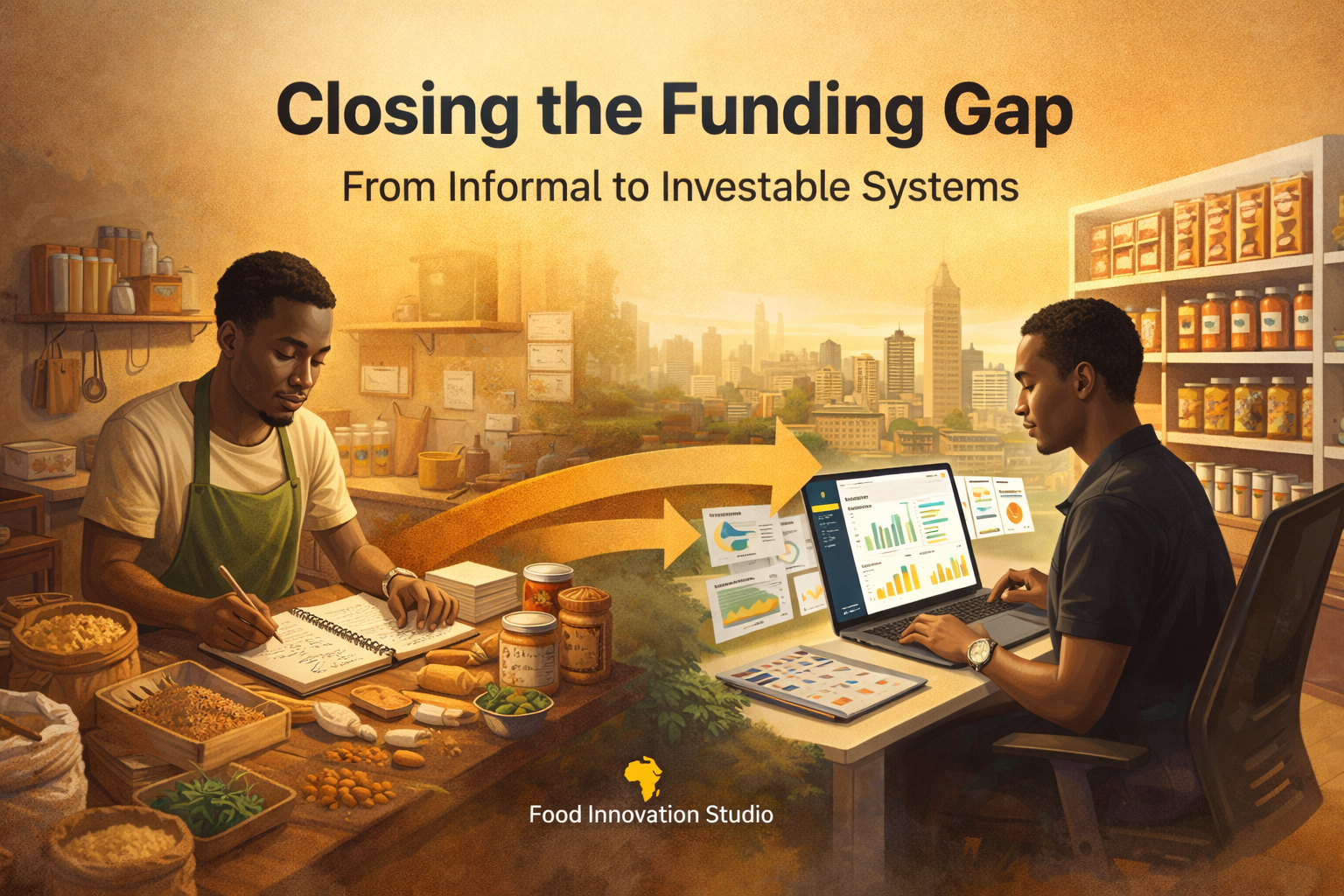
At Food Innovation Studio, we approach the funding gap as a system challenge rather than a financial one.
Our work focuses on three key areas:
1. Building Foundational Systems
We support startups in establishing financial discipline, operational consistency, and documentation processes. These elements are critical for both growth and investment readiness.
2. Structuring Market Pathways
We help founders identify and access viable markets, ensuring that production aligns with demand. This reduces risk and strengthens revenue visibility.
3. Enabling Capital Readiness
We work with startups to prepare them for engagement with investors and funders. This includes refining business narratives, structuring data, and aligning operations with investor expectations.
Bridging the Gap Between Founders and Capital
Closing the funding gap requires more than improving individual startups. It requires building stronger connections between founders and capital providers.
This involves:
- Translating operational realities into investor language
- Designing funding structures that match business needs
- Supporting transitions from informal to formal systems
It also requires collaboration between stakeholders, including governments, investors, development organizations, and ecosystem builders.
Looking Ahead: The Future of Food Investment in Africa
The future of Africa’s food sector is promising. Urbanization, population growth, and technological advancements are creating new opportunities for innovation and investment.
However, the success of this transformation will depend on the ability to build systems that support scale.
The next generation of successful food startups will not be defined by their ideas alone. They will be defined by their ability to:
- Operate consistently
- Scale sustainably
- Manage complexity
- Deliver value over time
Conclusion: From Funding Gap to System Opportunity
The funding gap in African food startups is real, but it is not insurmountable.
It is not simply a matter of increasing capital flows. It is a matter of improving readiness, strengthening systems, and aligning expectations.
At Food Innovation Studio, we believe that the path forward lies in building businesses that are not only innovative, but structured, disciplined, and scalable.
Because in the end:
Capital does not create strong businesses.
Strong businesses attract capital.