
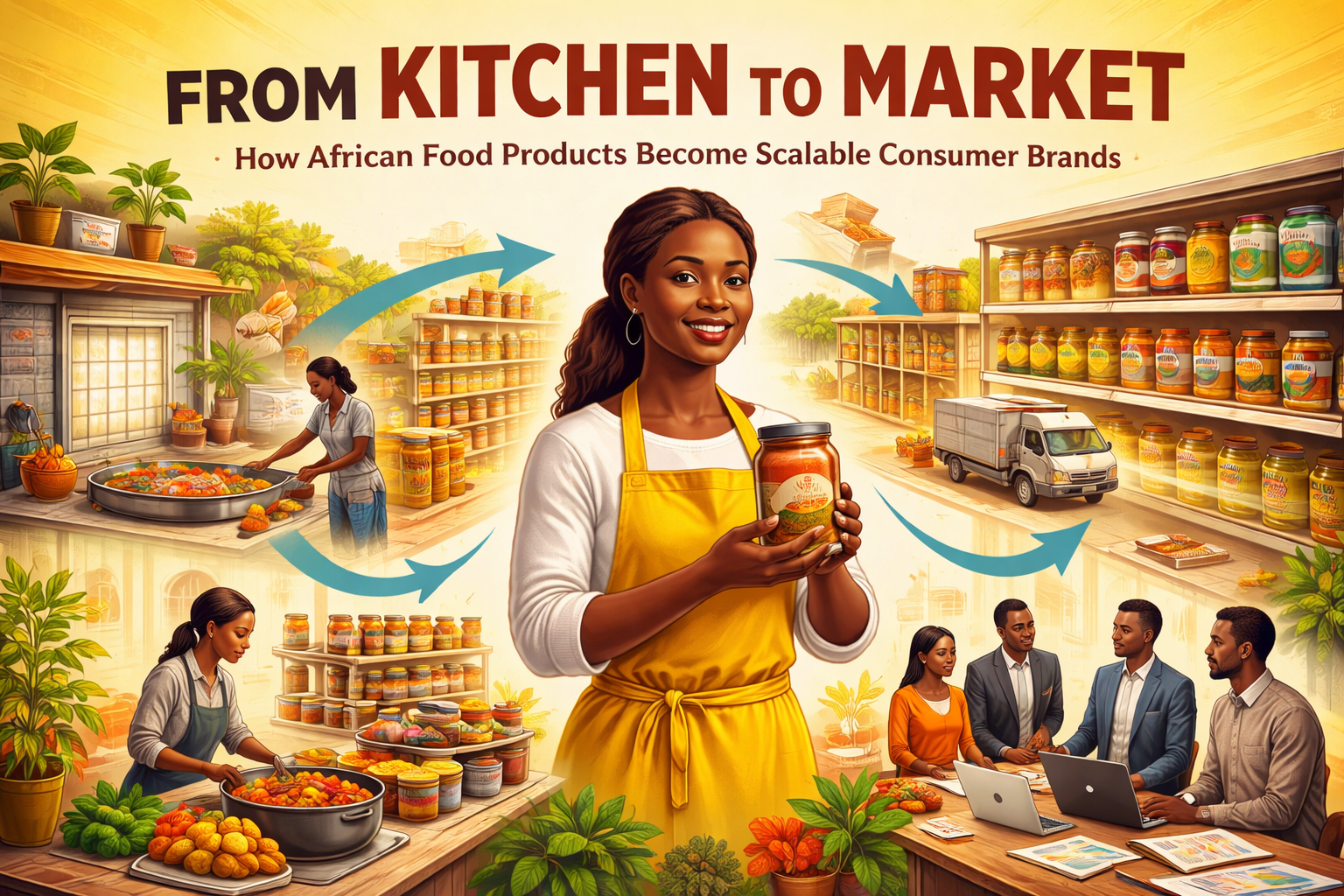
African food brands are standing at a pivotal intersection in their evolution. For decades, the continent’s food economy has been driven by informal systems, deeply embedded in culture, community, and tradition. These systems have produced some of the most diverse, rich, and authentic culinary experiences in the world. Yet, despite this depth, much of Africa’s food innovation has remained invisible at scale. Today, that is changing. A new generation of founders, operators, and ecosystem builders is transforming food from something consumed locally into something structured, branded, and scalable across regions and global markets.
At Food Innovation Studio (FiS), we see African food brands not as isolated businesses, but as systems that must be intentionally designed for scale. A system that begins in the kitchen, evolves through productization, gains legitimacy through compliance, builds power through branding, and achieves scale through infrastructure and distribution. This journey is not accidental. It is engineered. And understanding how it works is the key to unlocking Africa’s next generation of consumer brands.
Every scalable african food brand begins with something real. It begins in the kitchen. The kitchen represents origin. It is where recipes are refined through repetition, where taste is validated by real people, and where cultural identity is preserved. In many African contexts, the kitchen is not just a place of production; it is a space of knowledge transfer. Recipes are rarely written down. They are felt, adjusted, and perfected over time. This creates products that are deeply authentic but inherently inconsistent. What works in a kitchen environment, where intuition guides process, often struggles when exposed to scale.
The first major transition, therefore, is not about growth. It is about transformation. A food product must move from being an expression of craft to becoming a repeatable system. This requires discipline. It requires structure. It requires the ability to take something fluid and make it fixed without losing its essence. Standardization becomes critical. Measurements replace estimation. Processes are documented. Production is controlled. The goal is not to remove authenticity, but to preserve it in a form that can be replicated consistently.
This stage also introduces one of the most significant challenges in African food systems: perishability. Many traditional food products are designed for immediate consumption. They are fresh, vibrant, and highly perishable. While this is a strength in local contexts, it becomes a limitation when trying to reach broader markets. Extending shelf life is not just a technical requirement; it is a strategic necessity. It determines whether a product can move across cities, regions, or borders. It influences pricing, logistics, and accessibility. Techniques such as drying, fermentation, freezing, and modern preservation methods begin to play a critical role. These are not simply technical interventions; they are enablers of scale.
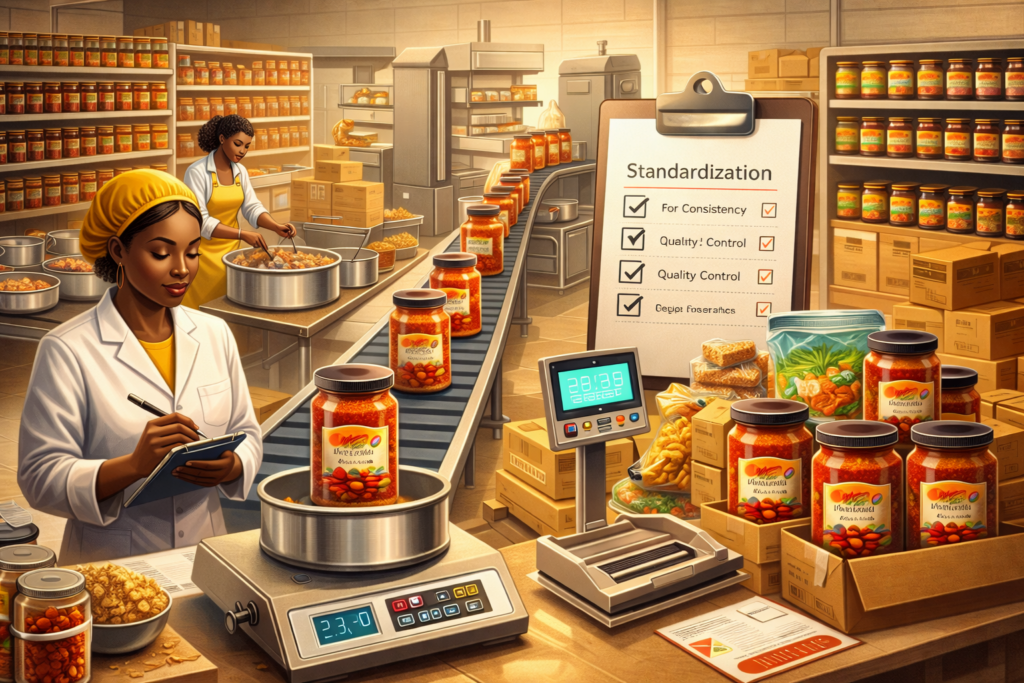
As the product becomes more structured, packaging emerges as a defining layer. In many early-stage food businesses, packaging is often treated as an afterthought, something to make the product look appealing. In reality, packaging is infrastructure. It determines how the product is stored, transported, and experienced by the consumer. It influences shelf life, protects against contamination, and communicates value. It is often the first point of interaction between the product and the market. In rapidly urbanizing African cities, where consumers are increasingly seeking convenience, packaging becomes a gateway to participation in modern retail environments. It transforms food from something consumed immediately into something that can be stored, displayed, and sold at scale.
However, even the most well-packaged product cannot grow without trust. Trust in food systems is built through compliance. This is the stage where a product moves from informal acceptance to formal recognition. It involves aligning with food safety standards, obtaining necessary certifications, adhering to labeling requirements, and establishing traceability. Compliance is what allows African food brands to move from local trust to institutional credibility. It opens doors to retail partnerships, institutional buyers, and investment opportunities. It signals to consumers that the product meets certain standards of quality and safety. In an environment where consumers are becoming increasingly conscious of what they consume, compliance becomes a competitive advantage.
At FiS, we describe this as building the trust layer of the food system. Without it, growth remains limited and fragile. With it, a product becomes investable, scalable, and credible.
How African Food Brands Build Identity and Trust
Once a product is compliant, the focus shifts from functionality to identity. This is where the transition from product to brand takes place. A product can satisfy a need, but a brand creates preference. It occupies a position in the consumer’s mind. It builds emotional connection. It differentiates itself in a crowded market. For African food brands, this stage presents a unique opportunity. The continent’s culinary heritage is rich with stories, traditions, and cultural significance. These elements, when translated into modern branding, create powerful narratives that resonate both locally and globally.
Branding is not just about logos or colors. It is about consistency of experience. It is about clarity of positioning. It is about understanding what the brand stands for and communicating that consistently across every touchpoint. Whether a brand positions itself around tradition, health, convenience, or premium quality, it must deliver on that promise every time. Storytelling becomes a critical tool in this process. It connects the origin of the product to its future. It gives consumers a reason to choose one product over another, even when the functional benefits are similar.
At this stage, many businesses begin to experience growth, but growth introduces new challenges. Demand increases, but supply must keep up. This is where supply chain becomes the backbone of scale. Across Africa, supply chains are often fragmented and unpredictable. Raw materials may vary in quality and availability. Logistics can be costly and inefficient. Infrastructure limitations can create bottlenecks. To navigate this complexity, scalable brands must build systems that ensure reliability.
This often involves developing direct relationships with producers, implementing aggregation systems to consolidate supply, and investing in processing infrastructure that can handle increased volumes. It also requires building distribution networks that extend beyond a single market. Distribution is not simply about getting products from point A to point B. It is about ensuring availability, visibility, and accessibility. It is about being present where consumers are, whether in formal retail stores, informal markets, or digital platforms.
Understanding the consumer is equally critical. Africa is not a single market, and consumer behavior varies significantly across regions, income levels, and cultural contexts. Successful brands are those that design for these realities. They understand that affordability is not optional. They recognize that quality cannot be compromised. They appreciate that convenience is increasingly important in urban environments. They build products and experiences that align with how people actually live, not how they are assumed to live.
At the intersection of these dynamics lies the concept of market fit. It is not enough to have a great product or a strong brand. The offering must align with consumer expectations, purchasing power, and usage patterns. Brands that fail to achieve this alignment often struggle to scale, regardless of their initial success.
As the business grows, the need for capital becomes more pronounced. Scaling production, expanding distribution, and investing in infrastructure all require financial resources. However, capital alone is not sufficient. It must be paired with clarity. Investors are increasingly looking for businesses that demonstrate not only potential, but also structure. They want to see systems that can support growth. They want to understand how the business will scale, how it will manage risk, and how it will generate returns.
This is why many African food brands struggle to attract investment. The opportunity is clear, but the systems are not always in place. At FiS, we emphasize that capital should accelerate growth, not validate it. The foundation must already exist. The systems must already be working. Investment then becomes a catalyst that amplifies what is already functional.
This brings us to the most important realization in the journey from kitchen to market. Scaling African food brands requires building resilient supply chains that can support consistent production. It is about building systems that can operate independently of the founder. It is about creating structures that ensure consistency, reliability, and efficiency. It is about integrating every layer of the business, from product development and compliance to supply chain and distribution, into a cohesive whole.
Technology is increasingly playing a role in enabling this integration. Digital tools are helping businesses forecast demand, track inventory, and understand consumer behavior. Data is providing insights that reduce uncertainty and improve decision-making. Platforms are connecting different parts of the value chain, creating new opportunities for collaboration and growth. While technology is not a substitute for strong fundamentals, it is an accelerator that can significantly enhance scalability.
Looking ahead, the future of African food will be shaped not just by individual brands, but by ecosystems. Food businesses are evolving from standalone entities into interconnected networks that facilitate production, distribution, and consumption. They are becoming platforms that enable multiple stakeholders to participate in the value chain. This shift represents a fundamental change in how food systems are organized and how value is created.
At Food Innovation Studio, this is the future we are building toward. We believe that Africa does not need more isolated products. It needs integrated systems that can support innovation, ensure compliance, enable distribution, and unlock capital. We are designing tools for food innovators to develop and scale their products. We are creating pathways for industry players to meet regulatory and operational standards. We are enabling investors to access structured opportunities that are grounded in real systems.
The journey from kitchen to market is not simple. It is not linear. It requires navigating multiple layers of complexity, each with its own challenges and opportunities. But for those who understand the system, who build intentionally, and who design for scale from the beginning, the opportunity is immense.
The future of African food brands will be defined by those who build systems, not just products. They are the ones that are structured, compliant, and deeply connected to the systems that enable scale. They are the ones that understand that growth is not a result of chance, but of design. They are the ones that move beyond the kitchen and build for the market.
We are not just bringing African food to market. We are designing how African food scales.