
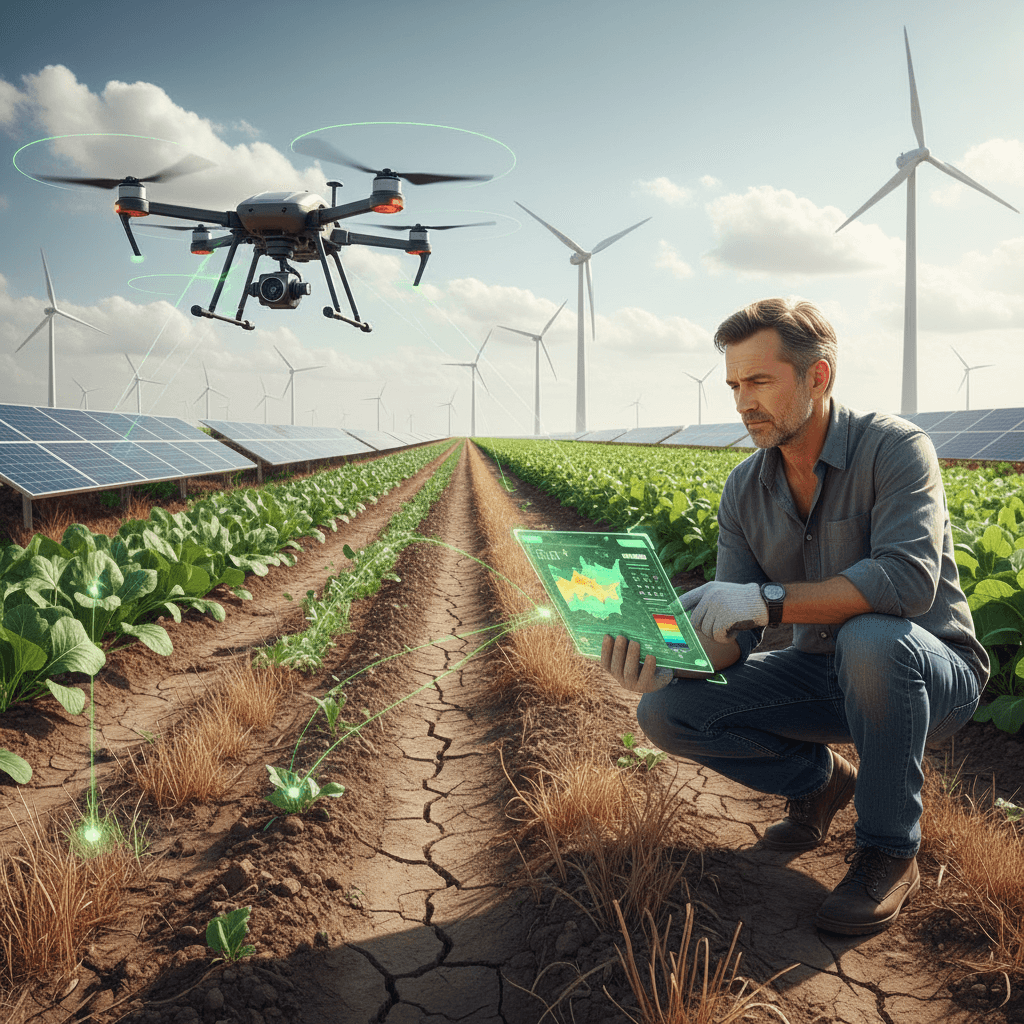
In the rolling hills of Kenya’s Central Province, Margaret Wanjiku tends her farm with a smartphone in one hand and traditional seeds in the other. This image represents the future of sustainable agriculture—a future where cutting-edge technology converges with ancient wisdom, and innovation is not a luxury but an absolute necessity for survival.
The global food system faces an unprecedented crossroads. We must increase food production by $70\%$ for a population projected to reach $9.7$ billion by 2050, all while reducing agriculture’s massive environmental footprint and adapting to a rapidly changing climate. This is not merely a technical challenge; it is a civilizational imperative demanding a complete reimagining of how we grow, distribute, and consume food.
The Triple Crisis Driving Agricultural Innovation
Innovation in agriculture is driven by an urgent convergence of environmental, resource, and social pressures.
1. Climate Change: The Accelerating Threat
Rising global temperatures and erratic weather patterns are fundamentally altering farming conditions. In sub-Saharan Africa, where agriculture employs $60\%$ of the population, climate change threatens to reduce crop yields by up to $20\%$ by 2050.
- Extreme Events: Droughts and extreme precipitation events are increasing, leading to widespread flooding, soil erosion, and crop failure.
- Adaptation: Farmers globally are forced to adopt drought-resistant varieties and precision irrigation systems just to maintain baseline productivity.
2. Resource Depletion: The Limits of Conventional Farming
Conventional agriculture’s reliance on finite resources is reaching a critical threshold.
- Topsoil Loss: Topsoil is being lost at rates far exceeding natural replenishment. The United Nations estimates that the world has only 60 harvests left before topsoil depletion makes large-scale agriculture impossible in many areas.
- Water Scarcity: Agriculture consumes $70\%$ of global freshwater, yet major aquifers are dropping precipitously, demanding innovative methods to optimize water use.
3. Food Security and Nutrition Gap
Nearly 800 million people are chronically undernourished. This paradox is compounded by the fact that the industrial focus on yield maximization has often led to nutrient dilution—crops today contain lower levels of essential nutrients than those grown decades ago. Sustainable solutions must address both the quantity and the nutritional quality of global food.
Innovation Frontiers: Technology Meets Tradition
The transformation to sustainable food production is being enabled by the convergence of digital and biological sciences with age-old wisdom.
Precision Agriculture: Data-Driven Farming
The digital revolution is transforming agriculture from intuition to precision. Using GPS, sensors, drones, and AI, farmers can apply inputs exactly where and when they are needed.
- Variable Rate Technology: Adjusts seed, fertilizer, and pesticide applications based on real-time field data, reducing input costs by $10-15\%$.
- AI and Analytics: Algorithms analyze vast datasets (satellite imagery, weather, soil sensors) to predict optimal planting times, identify potential disease outbreaks, and recommend management strategies tailored to specific field conditions.
- Democratization: In places like Kenya, smallholder farmers are using smartphone apps to receive personalized recommendations for pest and nutrient management.
Biotechnology and Genetic Innovation
Modern science is developing crops that require fewer inputs and can thrive in challenging climates.
- Climate Resilience: Drought-tolerant maize and salt-tolerant rice varieties maintain productivity with significantly less water, providing crucial resilience in stressed regions.
- Nutritional Enhancement: Gene editing (CRISPR) and other biotechnologies are used to develop crops enriched with essential nutrients like Vitamin A (e.g., Golden Rice), iron, and zinc, addressing micronutrient deficiencies globally.
Regenerative Agriculture: Working with Natural Systems
True sustainability requires actively rebuilding natural capital. Regenerative agriculture focuses on rebuilding soil health, enhancing biodiversity, and sequestering carbon.
- Core Practices: Practices like cover cropping, diverse crop rotation, and no-till farming prevent erosion, improve water retention, and enhance the soil microbiome.
- Agroforestry: Integrating trees with crops and livestock significantly enhances productivity while improving soil fertility, sequestering carbon, and providing shade.
Alternative Protein Production
Innovation in alternative proteins is addressing the environmental impact of conventional livestock.
- Cellular Agriculture: Produces meat from animal cells, dramatically reducing the land, water, and energy requirements of traditional protein production.
- Plant-Based Sophistication: Advanced alternatives are created to mimic the taste and texture of animal products while typically requiring $75-95\%$ less water and land.
Bridging the Gaps: Economics, Equity, and Policy
Scaling sustainable agriculture requires innovation that extends beyond the field to economic models and social structures.
New Economic Incentives
Current markets fail to account for environmental costs. New models create revenue streams for good stewardship.
- Carbon Markets: Soil carbon credits generated through regenerative practices (cover cropping, no-till) provide farmers with additional income while improving soil health and mitigating climate change.
- Payment for Ecosystem Services (PES): Programs compensate farmers for providing public benefits like water filtration, biodiversity conservation, and climate regulation.
Social and Equity Integration
Innovation must be accessible to the majority of the world’s producers: smallholder farmers.
- Smallholder Access: Programs like Farmer Field Schools and digital platforms must bridge the technological and financial divide to ensure smallholders can adopt sustainable practices.
- Gender Equity: Addressing systematic barriers that women farmers face in accessing land, credit, and technology is essential, as women comprise $43\%$ of the global agricultural labor force.
- Youth Engagement: Attracting younger generations requires agricultural education to emphasize sustainability, technology, and entrepreneurship, ensuring knowledge transfer and continuity.
Policy and Regulatory Support
Reforming policy is crucial, as current frameworks often favor conventional practices through subsidies that ignore environmental costs. Sustainable agriculture requires policy integration across trade, health, and environment sectors, backed by transparent traceability systems to create market premiums for responsibly produced food.
Conclusion: Necessity as the Mother of Innovation
The future of sustainable agriculture is being forged at the critical convergence of urgent necessity and human ingenuity. Climate change, resource scarcity, and food insecurity create the pressure; innovation provides the tools.
The path forward requires not just technological progress, but a shift in economic models, policy frameworks, and social structures that support equitable and regenerative practices. Farmers like Margaret Wanjiku, who blend ancient wisdom with modern technology, are proving that the challenges facing global food systems can be overcome.
The time for transformation is now. The future of human civilization depends on our wisdom and courage to embrace the innovations that necessity demands. 🌱