
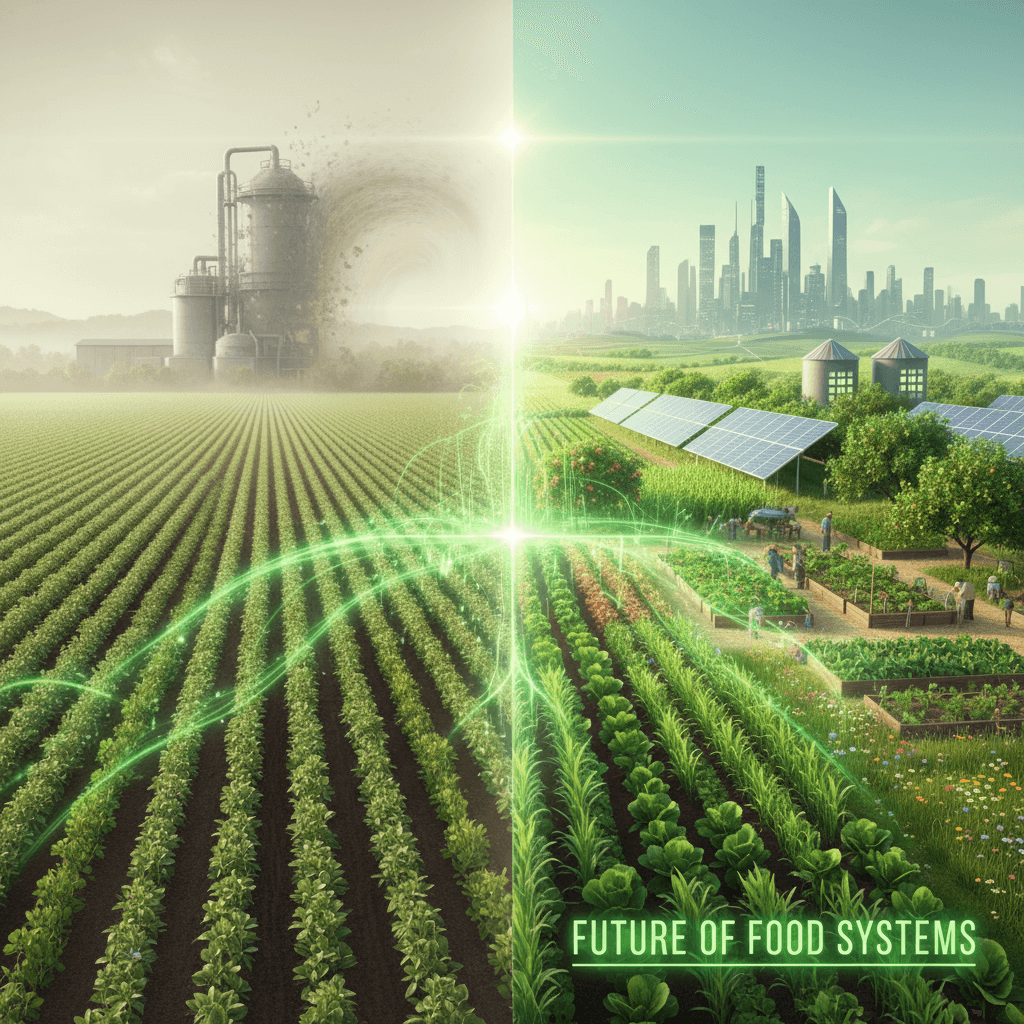
The global food system stands at a critical inflection point. Despite producing enough food to feed everyone, nearly one billion people remain hungry while two billion suffer from diet-related diseases. Our current system is the largest driver of environmental degradation, and this paradox reveals the fundamental inadequacy of our industrial approach.
The future of food systems demands a complete reimagining—not incremental improvements, but fundamental transformation guided by principles of sustainability, equity, resilience, and cultural authenticity. The challenge lies in creating systems that nourish both people and planet while respecting the diverse food traditions that make us human.
At The Food Innovation Studio, we believe that achieving a better future requires understanding food not just as a commodity, but as a driver of environmental health and a cornerstone of social justice.
The Unsustainable Status Quo: Why Transformation Is Necessary
The dominant global food system, built on 20th-century principles of efficiency and scale, achieved remarkable success in increasing output but at enormous hidden costs that are now critical.
The Environmental Toll
Industrial agriculture relies heavily on external inputs—synthetic fertilizers, pesticides, and fossil fuels—that have fundamentally altered natural cycles. Agriculture is responsible for $24\%$ of greenhouse gas emissions, $80\%$ of deforestation, and is the primary driver of habitat loss.
- Soil Degradation: Intensive farming has degraded one-third of global farmland, with soil erosion rates far exceeding natural regeneration.
- Genetic Erosion: The concentration of production in large-scale monocultures has drastically reduced biodiversity, leaving the entire food system vulnerable to climate shocks, pests, and disease.
The Equity Crisis
The food system fails to ensure equitable access to nutritious food. Hunger persists primarily due to poverty and inequality. The same system that generates vast profits leaves many food producers—especially women and smallholder farmers—unable to earn living wages.
The global shift toward processed foods, high in sugar and unhealthy fats, has created a double burden of malnutrition. This shift is driven by structures that make processed foods cheaper and more accessible than fresh, nutritious alternatives.
The Vulnerability of Long Supply Chains
Long, complex supply chains increase energy inputs, reduce freshness, and proved extremely vulnerable during the COVID-19 pandemic. Food travels an average of 1,500 miles from farm to plate, highlighting an intrinsic inefficiency that reduces food security even in regions with abundant local capacity. Food system transformation must address these structural weaknesses.
Principles for Food System Transformation
The future of food systems must be built on principles that restore natural systems, strengthen local economies, and prioritize equity.
1. Regenerative and Ecological Approaches
The future demands we move beyond simple sustainability to regenerative agriculture—actively healing damaged ecosystems while producing food.
- Soil Health: Regenerative practices focus on rebuilding soil health through cover cropping, diverse rotations, and integrated livestock management. Healthy soils sequester carbon, retain water, and support biodiversity.
- Agroecology: These approaches integrate ecological principles into farming, using biodiversity and natural processes to enhance productivity and resilience, often outperforming conventional agriculture under stress conditions like drought.
- Circular Economy: Applying circular principles maximizes resource efficiency—composting organic waste to rebuild soil, and using byproducts as feed or bioenergy—thereby eliminating waste.
2. Localization and Regional Resilience
While global trade is important, the future requires more localized and regionalized food systems that reduce transportation costs and increase freshness and security.
- Regional Food Hubs: These networks aggregate products from multiple small and medium-scale producers, providing market access while retaining economic value within local communities.
- Urban/Peri-urban Agriculture: Projects like vertical farms and community gardens provide fresh produce in densely populated areas, reducing transportation impact and creating local employment opportunities.
3. Equity, Justice, and Cultural Preservation
Transformation must address the structural inequalities that limit access to land and markets, while honoring cultural knowledge.
- Empowering Producers: Fair trade and direct marketing ensure farmers receive fair prices. Land reform and secure tenure rights enable smallholder farmers to invest in sustainable practices.
- Cultural Preservation: Traditional farming systems and food processing techniques (like fermentation) represent millennia of accumulated wisdom regarding sustainable production and nutritious diets. Innovation must enhance this wisdom, not diminish cultural authenticity.
New Economic and Policy Models
Achieving sustainable food systems requires new frameworks that account for the true environmental and social costs of production.
New Economic Models for Equity
Current food prices fail to reflect the environmental damage and health impacts of production.
- True Cost Accounting: This approach would internalize external costs (environmental damage, health impacts), creating market incentives for sustainable practices. This must be balanced with targeted subsidies to prevent cost burdens on low-income consumers.
- Cooperative and Solidarity Models: Producer cooperatives and Community-Supported Agriculture (CSA) offer alternatives to purely profit-driven systems. They build social capital, ensure fair prices for farmers, and maintain democratic control over enterprises.
Policy Integration and Governance
Policy must become coherent across sectors and inclusive of marginalized voices.
- Policy Coherence: We need to move beyond policy silos (agriculture, health, environment) that often create contradictions. Integrated food policies must align objectives so that, for example, agricultural policy supports public health goals.
- Participatory Governance: Transformation requires creating meaningful opportunities for farmers, food workers, and indigenous communities to participate in decision-making, shifting governance power away from entrenched corporate interests.
Technological Innovation for Transformation
Technology is a powerful tool for transformation when applied thoughtfully, inclusively, and in service of ecological health.
- Precision Agriculture: Uses sensors, GPS, and data analytics to optimize resource use (water, fertilizer), reducing environmental impact while maintaining yields.
- Democratizing Digital Tools: Mobile platforms provide smallholder farmers in developing regions with critical information, such as weather forecasts and market prices, helping them build resilience.
- Genetic Innovation: Gene editing (like CRISPR) and traditional breeding can develop crops that are more disease-resistant, climate-resilient, and nutritious, without heavy reliance on external inputs.
- Alternative Protein Systems: Plant-based proteins and cellular agriculture offer opportunities to significantly reduce the environmental footprint associated with conventional animal protein production, provided they are developed with attention to accessibility and cultural preference.
Conclusion: Toward Resilient and Equitable Food Futures
The transformation of global food systems is an imperative. The future demands that we reject the false choice between efficiency and sustainability, tradition and innovation. Instead, we must create systems that integrate the best of all approaches: honoring cultural wisdom while embracing the tools needed to address contemporary challenges.
The path forward requires unprecedented cooperation, new economic models that value social and environmental outcomes, and governance that includes marginalized voices. The transformation will not be easy, but the alternative—a system that fails both people and planet—is unacceptable.
The future of food is not predetermined. It is being shaped by every decision we make today, starting with the recognition that food is a fundamental expression of our relationship with each other and with the natural world.