
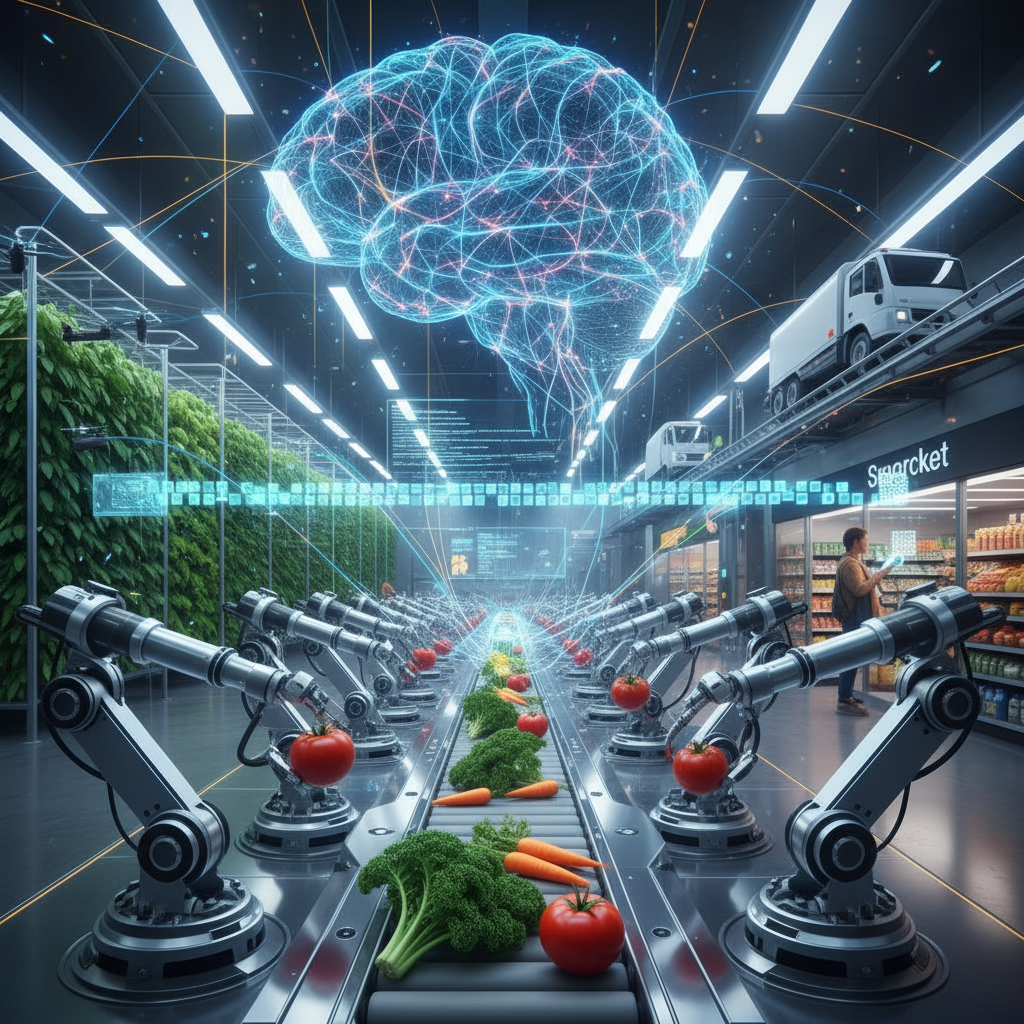
The globalization of our food supply, coupled with threats from climate change and evolving consumer demands, has made traditional food safety methods obsolete. The stakes are immense: Foodborne illnesses affect over 600 million people annually and cost the global economy more than $\$100$ billion. 📉
To combat these challenges, the industry is undergoing a digital revolution. Food Safety Technology (FST) is shifting from a slow, reactive process to one that is predictive, real-time, and transparent.
This guide explores the emerging reality of the next wave of FST, detailing how artificial intelligence (AI), blockchain, IoT sensors, and advanced biotechnology are making our food supply safer, more resilient, and more traceable from farm to fork.
The Digital Revolution: From Reactive to Predictive Food Safety
For decades, food safety relied on the Hazard Analysis and Critical Control Points (HACCP) system. While foundational, HACCP remains largely reactive, focusing on periodic testing and manual record-keeping after contamination risks emerge. Traditional testing can take days or weeks, meaning contaminated products may already be in consumers’ hands.
The shift to Predictive Food Safety is enabled by the convergence of digital technologies:
- IoT (Internet of Things): Provides continuous, real-time monitoring.
- Artificial Intelligence (AI): Enables pattern recognition and risk prediction.
- Blockchain: Ensures data integrity and immutable traceability.
- Rapid Diagnostics: Delivers laboratory-quality results in the field.
Instead of waiting for contamination, these integrated systems use real-time data to anticipate and prevent safety issues before they can happen, dramatically reducing waste and protecting public health.
AI and Machine Learning: The Brain of Modern Food Safety
Artificial Intelligence in Food Safety transforms vast amounts of data—from environmental sensors, production records, and microbial activity—into actionable insights. AI systems are the engine driving predictive prevention.
Pattern Recognition and Anomaly Detection
Machine Learning algorithms excel at identifying subtle patterns that human inspectors would miss.
- Manufacturing: AI systems analyze high-resolution images of products (e.g., meat carcasses or fresh produce) to detect visual contamination or defects with consistency and speed that exceed human capabilities.
- Predictive Analytics: AI models forecast the likelihood of outbreaks (like Salmonella or E. coli) based on environmental data such as temperature, humidity, and rainfall patterns, allowing for targeted prevention measures before peak risk times.
- Computer Vision: Camera-based systems analyze color, texture, shape, and size variations to sort and remove potentially unsafe items from a production line.
Predictive Modeling and Risk Assessment
AI allows for dynamic risk assessment, continuously updating predictions based on live data. For example, if a cold storage sensor flags a temperature excursion, the system immediately calculates the risk to specific, temperature-sensitive products, prioritizing them for action.
This capability moves food safety beyond simple checklist compliance to true, continuous risk management.
Blockchain and DLT: Ensuring Trust and Transparency
Blockchain technology is revolutionizing food traceability by creating an immutable, distributed ledger that cannot be altered or falsified. Every handling event, temperature reading, and compliance check is recorded, linking the final product back to its origin.
Immutable Traceability Systems
- End-to-End Visibility: Customers can scan a QR code on a product to access its complete journey—from the farm or fjord to the shelf—including processing details and quality data. This level of transparency builds essential consumer trust.
- Rapid, Targeted Recalls: When contamination does occur, a blockchain food traceability system can pinpoint the source and scope of the problem in minutes, not days. This enables targeted recalls that remove only the affected batch, drastically reducing economic waste and public exposure.
Supply Chain Verification
Blockchain smart contracts automatically verify supplier credentials, ensuring that every participant in a complex global supply chain meets safety and compliance standards. This digital verification is a powerful tool in combating food fraud, which is particularly prevalent in high-value markets like organic produce or specialty goods.
IoT and Smart Sensors: The Real-Time Monitoring Revolution
The Internet of Things (IoT) provides the physical eyes and ears across the food system, delivering the continuous data streams that fuel AI and blockchain platforms. 📡
Environmental Monitoring and Control
- Cold Chain Management: IoT sensors track temperature, humidity, and location throughout refrigerated transport and storage. If a temperature threshold is crossed, the system generates immediate alerts and documents the excursion for compliance purposes.
- Automated Quality Control: In processing facilities, sensors provide feedback loops to automated control systems, constantly adjusting parameters like $\text{pH}$ and moisture to maintain optimal safety conditions.
- Smart Packaging: Sensors embedded in packaging can monitor the product’s condition after it leaves the processing facility, alerting consumers or retailers to spoilage or temperature abuse.
Portable Diagnostics and Rapid Testing
Traditional lab tests take time, money, and expertise. New diagnostic technologies are bringing laboratory quality to the field, factory, and farm.
- Molecular Diagnostics: Devices using technologies like real-time PCR can detect specific pathogens (Salmonella, Listeria) in minutes, not days. Simpler methods, such as LAMP technology, are becoming increasingly portable and suitable for resource-limited settings.
- Biosensors: These use biological elements (like antibodies) to detect contaminants. Lateral flow immunoassays (similar to a pregnancy test) provide quick, visual results for non-technical personnel, ideal for field testing.
- Spectroscopic Analysis: Handheld devices use near-infrared (NIR) and Raman spectroscopy to perform rapid chemical analysis without sample preparation, identifying adulterants and chemical residues instantly.
Implementation Challenges and The Path Forward
The promise of the next wave of Food Safety Technology is immense, but several practical challenges must be addressed for widespread, effective adoption.
Economic and Accessibility Barriers
The high initial capital cost of advanced systems is a major hurdle for smallholder farmers and small-to-medium enterprises (SMEs), particularly in developing countries.
- Solution Focus: Solutions must be scalable and accessible. This means promoting low-cost sensors, simplified testing methods, and mobile-first approaches that leverage widely adopted smartphones for data capture and communication. Cooperative purchasing and leasing models can also make sophisticated tools affordable.
Data Interoperability and Governance
Integrating data from dozens of different sensors, legacy systems, and proprietary software platforms is complex.
- Solution Focus: Industry-wide collaboration on data standardization and the development of robust Application Programming Interfaces (APIs) are essential to ensure all systems can communicate seamlessly and integrate into a comprehensive food safety ecosystem.
Ethical and Human Integration
Technology must enhance, not replace, human expertise. The most successful implementations ensure that the technology is intuitive, reliable, and culturally appropriate for the diverse people who work across the food system.
The core mission remains the same: to produce safe, nourishing food. By combining the power of predictive technology with human knowledge and a commitment to equity, we can build a future of food systems that are worthy of the trust placed in them every day. 🍏