
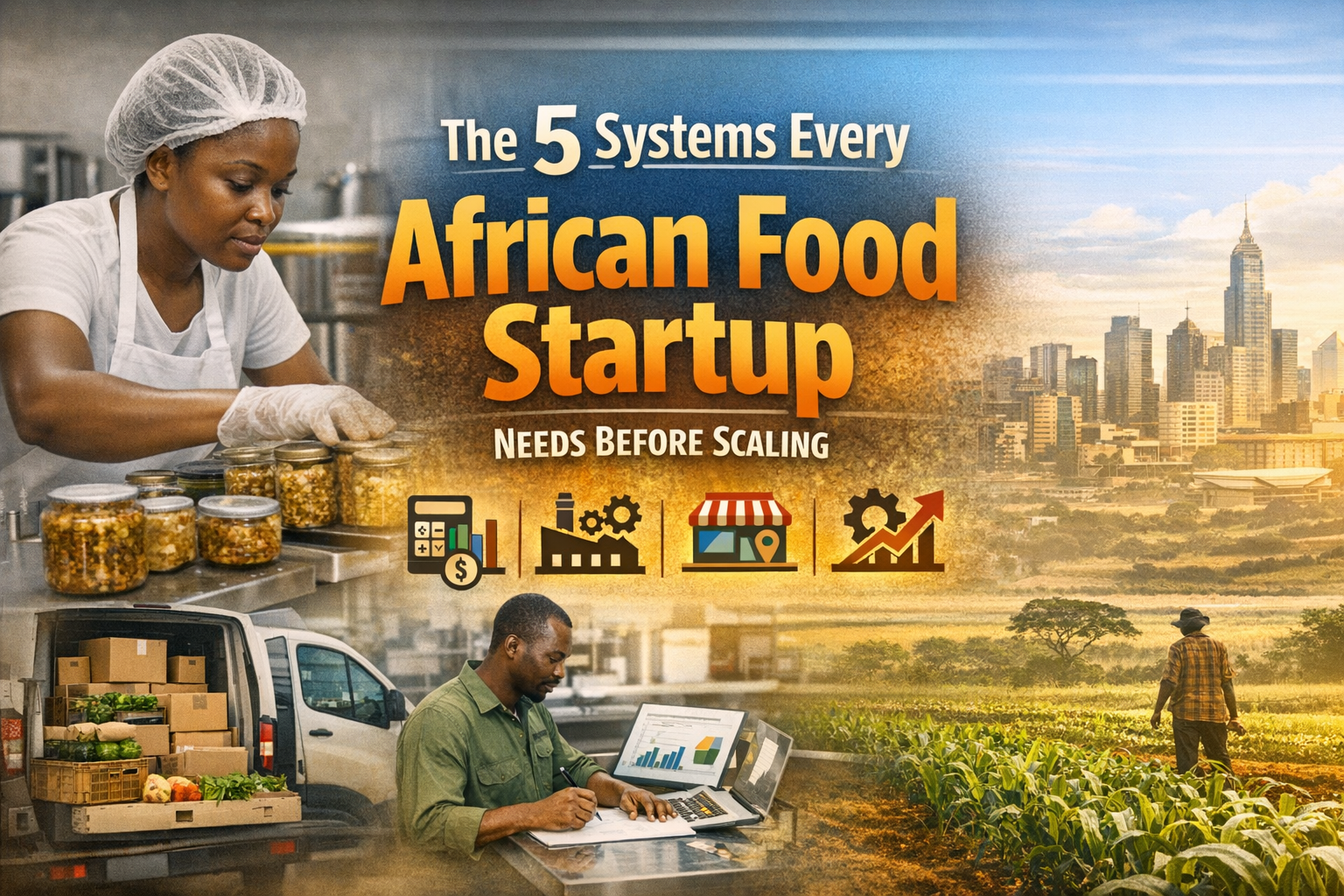
Africa’s food ecosystem is experiencing a quiet revolution.
Africa’s food ecosystem is undergoing a significant transformation. Across the continent, a new generation of entrepreneurs is building innovative food businesses that blend cultural heritage with modern commercial potential. From packaged goods to contemporary restaurant concepts, the opportunity is vast.
Yet despite this growth, one challenge remains consistent. Many African food startups fail before they ever reach scale. This failure is rarely due to poor ideas or lack of demand. Instead, it is most often the result of missing systems.
At Food Innovation Studio, we have observed that successful scaling is not driven by effort alone. It is driven by structure. Scaling a food business is not about doing more; it is about building the right systems that can support growth.
This article explores the five essential systems every African food startup must establish before attempting to scale.
Financial Systems: The Foundation of Sustainable Growth
One of the most critical yet overlooked areas in early-stage food businesses is financial management. Many founders operate without structured financial systems, relying instead on informal tracking and intuition. While this may work in the very early stages, it becomes a major limitation when growth begins.
Financial systems provide clarity. They help founders understand the true cost of production, identify profit margins, and manage cash flow effectively. Without this clarity, businesses often appear profitable on the surface while struggling behind the scenes.
Why Financial Systems Matter
Scaling requires a clear understanding of numbers. Founders must know how much it costs to produce their products, how pricing affects margins, and how much capital is required to expand operations. Investors, in particular, expect structured financial data before committing resources.
Without proper financial systems, raising capital becomes difficult, and decision-making becomes reactive rather than strategic.
Building a Strong Financial Foundation
A well-structured financial system should enable consistent tracking of costs, revenues, and cash flow. It should also support financial planning and forecasting, allowing the business to anticipate future needs and opportunities.
Ultimately, strong financial systems transform a business from guesswork to informed decision-making. They create the foundation upon which sustainable growth is built.
Production and Operations Systems: Enabling Consistency at Scale
Many African food startups begin with small-scale production, often in informal settings such as home kitchens or small workshops. While this approach is effective for testing ideas, it presents challenges when demand begins to increase.
The transition from small-batch production to scalable operations requires structured systems that ensure consistency and efficiency.
The Challenge of Scaling Production
As demand grows, inconsistencies in product quality can emerge. Processes that were once manageable become inefficient, and the lack of standardization makes it difficult to meet larger orders.Without proper operations systems, businesses risk damaging their reputation and losing valuable growth opportunities.
Building Scalable Operations
Production systems should be designed to ensure consistency in quality and output. This involves documenting processes, establishing clear workflows, and implementing quality control measures.
In addition, supplier relationships and production planning must be structured to support increased demand. Over time, introducing basic automation can further improve efficiency and reduce reliance on manual processes.
Consistency is the key to scaling production. It is not enough to produce more; businesses must produce reliably and efficiently.
Market and Distribution Systems: Reaching Customers at Scale
A strong product alone is not enough to guarantee success. Without effective market and distribution systems, even the best products struggle to reach their intended audience.
Many startups initially rely on direct sales, social media, and word-of-mouth marketing. While these channels are valuable, they are not sufficient for sustained growth.
The Importance of Distribution
Scaling requires a shift from individual sales efforts to structured distribution systems. This involves identifying target markets, establishing reliable sales channels, and building partnerships that enable wider reach.
Distribution systems determine how efficiently a product moves from production to the customer. Without them, growth remains limited.
Developing a Market Strategy
A strong market and distribution system begins with a clear understanding of the target customer. From there, businesses must develop a go-to-market strategy that outlines how products will be sold and delivered.
This may include retail partnerships, wholesale distribution, digital sales platforms, and logistics solutions. Each component must work together to create a seamless pathway from production to consumption.
Ultimately, it is not the product that scales, but the system that delivers it to the market.
Brand and Customer Experience Systems: Building Trust and Loyalty
In the food industry, trust is a critical factor in customer decision-making. Consumers are not only purchasing a product; they are engaging with a brand and the experience it offers.
Branding, therefore, extends beyond visual identity. It encompasses the entire customer journey, from first interaction to repeat purchase.
The Role of Branding in Growth
A strong brand differentiates a business in a competitive market. It communicates value, builds recognition, and fosters emotional connections with customers.
Without a clear brand strategy, businesses struggle to stand out and often compete primarily on price.
Creating a Consistent Customer Experience
Brand and customer experience systems ensure that every interaction with the business is consistent and aligned with its identity. This includes packaging, messaging, customer service, and storytelling.
By creating a cohesive experience, businesses can build trust and encourage loyalty. Over time, this trust translates into repeat customers and stronger market positioning.
Consistency in brand experience is what transforms a product into a recognizable and trusted brand.
Governance and Growth Systems: Structuring for Long-Term Success
As a business grows, complexity increases. Teams expand, operations become more intricate, and decisions carry greater impact. Without proper governance systems, this complexity can lead to confusion and inefficiency.
Governance systems provide structure. They define how decisions are made, how responsibilities are assigned, and how performance is measured.
The Need for Structure
In early stages, startups often operate informally, with founders managing multiple roles. While this flexibility can be beneficial initially, it becomes unsustainable as the business scales.
Clear structures are needed to ensure accountability and alignment across the organization.
Building for Sustainable Growth
Governance systems should establish defined roles and responsibilities, enabling teams to operate effectively. Decision-making frameworks help guide strategic choices, while performance metrics provide insight into progress.
A well-defined growth roadmap ensures that expansion is intentional and aligned with long-term goals.
Structure is what allows growth to be sustained. Without it, even successful businesses can struggle to maintain momentum.
Systems Versus Hustle: A Shift in Mindset
There is a strong culture of hustle within Africa’s entrepreneurial ecosystem. While this mindset is valuable in the early stages, it is not sufficient for long-term success.
Hustle can help a business get started, but it cannot sustain growth. Systems, on the other hand, provide the stability and scalability needed for long-term success.
The most successful food startups are not necessarily those with the most innovative ideas. They are the ones that have built the strongest systems.
How Food Innovation Studio Supports Food Startups
At Food Innovation Studio, our focus is on helping founders transition from informal operations to structured businesses. We work across key areas such as financial systems, production optimization, market strategy, brand development, and growth planning.
Our approach is rooted in the belief that sustainable success comes from strong foundations. By building the right systems, startups can position themselves for long-term growth and resilience.
Conclusion: Build Systems Before You Scale
Scaling is often seen as the ultimate goal for startups. However, without the right systems in place, scaling can amplify existing weaknesses and lead to failure.
Before expanding operations or entering new markets, founders must ensure that their business is built on a strong foundation. Financial clarity, operational consistency, effective distribution, strong branding, and structured governance are all essential components of this foundation.
The question is not whether a business is ready to grow, but whether it is prepared to sustain that growth.
In the end, success is not determined by how fast a business scales, but by how well it is built.